






One of the most asked questions in India when it comes to government jobs is about the MTS Havaldar salary. Hundreds of thousands of Class 10 pass-outs each year enroll for the Staff Selection Commission (SSC) Multi-Tasking Staff (MTS) and Havaldar exam for a steady central government job, good starting salary with some yojnas salaried after that, and long-term financial security. Whether you are preparing for this exam or simply searching for what this job pays as an MTS Havaldar, here is a complete guide breaking down the entire structure of the MTS Havaldar salary 2026 – basic pay, dearness allowance, house rent allowance, deductions, in-hand salary, job profile, perks and career growth.
What Is the MTS Havaldar Post?
The SSC MTS & Havaldar are a group of Posts in Pay Level 1 (Rs. 18000- 56900), classified as Group “C”, Non-Gazetted, and Non-Ministerial, which are recruited through a single combined examination conducted by the Staff Selection Commission. MTS staff are placed in different ministries, divisions, and departments of the central government, while posts of Havaldar come only from the Central Board of Indirect Taxes and Customs (CBIC) and the Central Bureau of Narcotics (CBN). As both posts are of the same pay level and advertised together, aspirants as well as coaching platforms talk about the combined pay structure of both roles under a single package.
MTS Havaldar Salary 2026: Quick Overview
Before delving into the specifics, here is a quick overview of the MTS Havaldar salary for 2026.
| Particulars | Details |
| Recruiting Body | Staff Selection Commission (SSC) |
| Post Names | Multi-Tasking Staff (MTS) & Havaldar |
| Pay Commission | 7th Pay Commission |
| Pay Level | Level 1 |
| Pay Band | Rs. 5,200 – Rs. 20,200 |
| Grade Pay | Rs. 1,800 |
| Basic Pay (Entry Level) | Rs. 18,000 |
| Maximum Basic Pay | Rs. 56,900 |
| Gross Monthly Salary (Approx.) | Rs. 25,000 – Rs. 35,000 |
| In-Hand Salary (Approx.) | Rs. 27,000 – Rs. 31,000 |
| Job Type | Group C, Non-Gazetted, Non-Ministerial |
While this table provides a good idea of the expectations, take-home pay/Salary Account of a candidate largely depends upon the city of posting, Dearness Allowance (DA) applicable according to the place, and deductions applied to the gross salary.
You May Also Know About: CHO Salary in Rajasthan 2026 | IAS Salary 2026
Pay Scale and Pay Matrix
This pay is at Pay Level 1 of the 7th Central Pay Commission (CPC) Pay Matrix. In September last year, the pay commission had graded this as the entry-level pay band for Group C employees in the centre. Now, the minimum basic pay at this level starts from Rs. 18,000 per month and reaches up to a maximum of Rs. 56,900 through annual increments over a career span.
MTS and Havaldar posts get the same basic pay of Rs. 18,000 at the entry level, and thus their take-home pay is almost at par with one another. The difference in salary comes from department-specific allowances rather than the pay scale itself. But Havaldar candidates have to pass an additional Physical Efficiency Test (PET) as well as a Physical Standard Test (PST) during the selection process because more physically tiring work is expected from them than from a regular MTS post.
Components of the Salary Structure
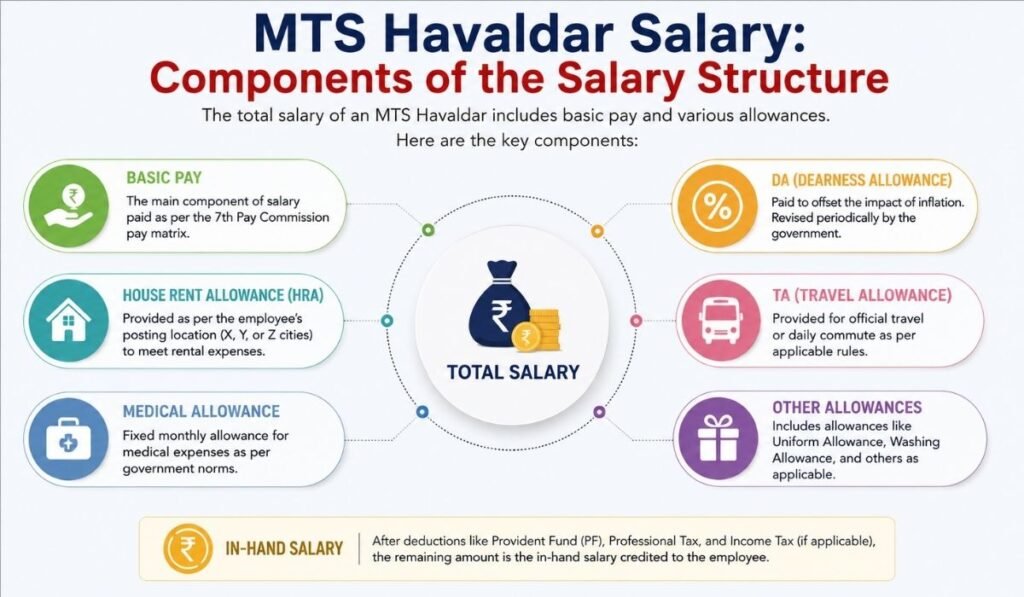
This Payment Package is not merely the standard payment number. It’s an amalgamation of many elements, which form its gross salary, and from which deductions are made, giving the final in-hand amount. The formula used is:
Basic Pay + Allowances (DA + HRA + TA) − Deductions = Net In-Hand Pay
1. Basic Pay
Under the Pay Matrix, Level 1: MTS and Havaldar Basic pay starts from Rs. 18,000/- per month. This is the figure upon which everything else is based.
2. Dearness Allowance (DA)
DA is a cost-of-living allowance granted to compensate employees against inflation. The index that has been in consideration is revised biannually (January and July), as per the All India Consumer Price Index. After increasing on 1 July 2025, the DA rate will be about 58% of basic pay for central government workers in mid-2026.
3. House Rent Allowance (HRA)
The submission location classification of a city has a role in HRA. We classify cities in X (metro), Y (tier-2), and Z (smaller town) groups, with the HRA percentage varying accordingly.
4. Transport Allowance (TA)
TA is a flat allowance to meet transport costs and varies slightly across city categories, usually between Rs. 900 and Rs. 1350 per month for Level 1 employees.
MTS Havaldar Salary: City-Wise In-Hand Salary Table
HRA and TA vary with city categories, and therefore, the final pay also depends on the city of posting for an employee. Below is the approximate in-hand salary breakup for X, Y, and Z category cities.
| City Category | Example Cities | HRA (% of Basic) | Approx. In-Hand Salary |
| X (Metro) | Delhi, Mumbai, Bengaluru, Chennai, Kolkata, Hyderabad | 27% | Rs. 30,500 – Rs. 31,500 |
| Y (Tier-2) | Lucknow, Jaipur, Chandigarh, Bhopal, Patna | 18% | Rs. 28,500 – Rs. 29,500 |
| Z (Others) | Smaller towns and rural postings | 9% | Rs. 27,000 – Rs. 28,000 |
With reference to the table above, an employee posted in a metro or X-category city receives a significantly higher take-home salary than one posted in a Z-category town, only due to the HRA differential. This is one of the main drivers that determines what actually hits an employee’s account each month.
You May Also Know About: ASO in CSS Salary 2026: Pay Scale | IAS Salary After 5 Years
Detailed Salary Breakup Table
A detailed breakdown (taking the city of X as a reference point) of how gross salary is computed before deductions.
| Component | Amount (Approx.) |
| Basic Pay | Rs. 18,000 |
| Dearness Allowance (58% of Basic) | Rs. 10,440 |
| House Rent Allowance (27% of Basic) | Rs. 4,860 |
| Transport Allowance | Rs. 1,350 |
| DA on Transport Allowance | Rs. 783 |
| Gross Salary | Rs. 35,433 |
| Less: NPS Contribution (10% of Basic + DA) | Rs. 2,844 |
| Less: CGHS/CGEGIS & Other Deductions | Rs. 1,300 (approx.) |
| Net In-Hand Salary | Rs. 31,000 (approx.) |
Disclaimer: These figures are indicative and may vary slightly depending on the concerned department, local allowances (if any), and as per revision from time to time by the Government of India.
MTS vs Havaldar Salary: Is There a Difference?
One frequently asked question to needy hopeful applicants is whether MTS Havaldar Salary is different from the havaldar wage (since both are vide the same recruitment notification ). The simple answer is that the pay itself is the same for both services, as they are in the same Level 1 of the Pay Matrix with a basic pay of Rs. 18,000. The table below highlights the main distinctions.
| Parameter | MTS | Havaldar |
| Basic Pay | Rs. 18,000 | Rs. 18,000 |
| Pay Level | Level 1 | Level 1 |
| Department | Various ministries | CBIC & CBN only |
| Physical Test Required | No | Yes (PET/PST) |
| Nature of Duty | Office-based, clerical support | Physically demanding, security-related |
| In-Hand Salary Range | Rs. 27,000 – Rs. 31,000 | Rs. 27,000 – Rs. 31,000 |
As for pay, while the take-home is almost similar on paper in both posts, the Havaldar job is considered slightly more arduous due to the physical requirements of the role, and some are enticed by additional perks such as allowances and other uniform-related benefits made available at select postings.
Job Profile and Responsibilities
You get a good sense of daily responsibilities, and that helps to contextualize this pay scale with the actual work. Typical duties include:
- General cleanliness of the office or section
- Transporting files and papers inside the office
- Any other office tasks like photocopying, scanning, and basic operation of office machines
- Dak (Mail) delivery inside and outside the building
- Watch and ward, including opening/closing of rooms
- Helping with physical files maintenance
- For Havaldar, an additional Customs and narcotics enforcement support role
You are trained on data from early November 2023, which is one of the reasons this job offers good value with relatively low stress and a steady and sensible workload when compared to many government roles.
Perks and Benefits Beyond the Monthly Pay
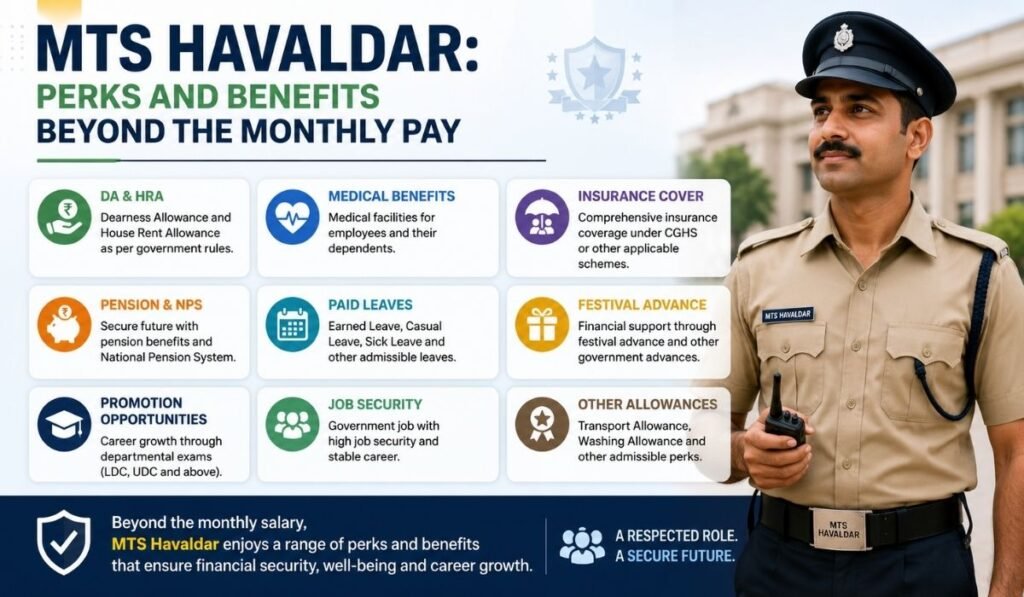
Apart from the monthly in-hand pay, employees enjoy several additional benefits that add long-term value to the overall compensation package:
| Benefit | Details |
| Pension (NPS) | National Pension System contribution with government matching |
| Medical Facility | CGHS coverage for employee and their dependent family members |
| Group Insurance | CGEGIS coverage provides life insurance benefits |
| Leave Travel Concession (LTC) | Travel reimbursement for self and family periodically |
| Provident Fund | Retirement savings accumulated over the service period |
| Gratuity | Lump-sum payment on retirement after qualifying service |
| Job Security | Permanent, pensionable central government employment |
Since this compensation package includes many perks, the actual value of this compensation package looks much higher than the gross in-hand figure once long-term assets, including retirement and medical benefits, are included.
You May Also Know About: Food Inspector Salary in India 2026 | MBA in Finance Salary 2026
Career Growth and Promotion
The most appealing part about this career path is not so much the initial number itself but rather how that figure increases over the years. Employees eventually rise through the following stages:
- MTS/Havaldar (Entry Level) – Starting Salary Rs. 18,000, Level 1
- Raises- Senior MTS/Havaldar – After a few years of service with gradual pay hikes
- Promotional examinations for the Lower Division Clerk (LDC), 2nd-level band.
- Upper Division Clerk (UDC) – Promotional Increment, Pay Scale Level 4
- Assistant/Section Officer – a higher-level executive with a much higher salary
Rise through department-based exams, seniority, and availability of vacancies; these determine promotion, and compensation is based on a relative scale from an entry point level, which most start at clerical/administrative cadres with much better pay within 15–20 years.
Factors That Affect the Take-Home Pay
Various factors come into play to determine how much an individual employee takes home in hand:
- City of Posting: We can classify cities by X, Y, or Z category cities to calculate HRA and your overall take-home, too.
- DA Revision: Incremental increases in the gross salary depending on bi-annual DA hikes.
- Department: A few departments may provide additional supplements for localם
- Discounts: NPS, CGHS, and other categorical discounts differ at particular levels
- Increment: Your basic pay component rises every year, incrementally per annum
MTS Havaldar Salary After 3, 5, and 10 Years
| Years of Service | Approx. Basic Pay | Approx. In-Hand Salary |
| At Joining | Rs. 18,000 | Rs. 27,000 – Rs. 31,000 |
| After 3 Years | Rs. 19,600 | Rs. 29,000 – Rs. 33,000 |
| After 5 Years | Rs. 20,800 | Rs. 31,000 – Rs. 35,000 |
| After 10 Years | Rs. 23,900 | Rs. 36,000 – Rs. 40,000 |
The above figures are based on standard annual increases and periodic DA revisions; actual numbers may be less depending upon promotions won in departmental exams over the period.
How Does It Compare to Other Entry-Level Government Jobs?
This pay scale is similar to some other Class 10 and Class 12 level government jobs, like Railway Group D, Anganwadi Worker, or many state police constable posts; the difference being entry level salary often varies by state and department. The central government pension, CGHS medical facility, and the option of getting settled in clerical categories through internal promotion, something that most state-level entry-level jobs do not offer to such an extent, is what make this job special.
Before knowing where to prepare amongst these options, aspirants actually analyze notification cycles, number of vacancies, and exam difficulty across them, and consistently, MTS/Havaldar ends up being the post with candidates only holding a 10th-pass qualification listed as one of the easier ones.
Tips for Aspirants Preparing for the Exam
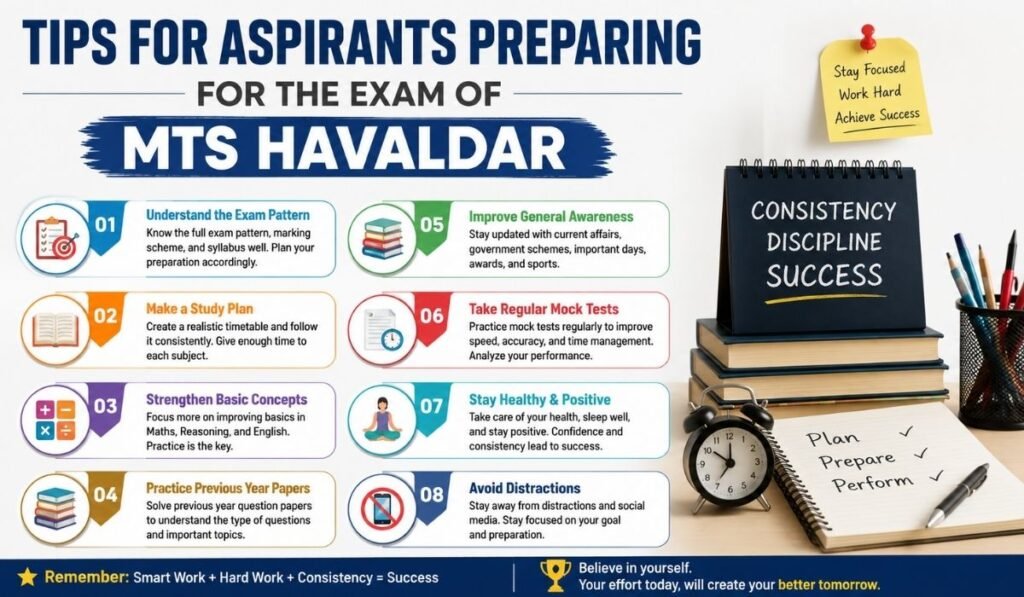
Selection is exhaustive, and lakhs of candidates will be competing for a few vacancies every year; therefore, students preparing for this examination have to follow a systematic study plan covering General Intelligence & Reasoning, Numerical Aptitude, General English, and General Awareness. Finally, practicing for traditional test formats (like MCQs) through last year’s exam papers and mock tests would give you more grip on how to attempt the examination with speed and precision, an essential trait in a time-bound online paper.
Exercising physical fitness preparation is almost equally important for candidates who will specifically be aiming for the Havaldar post itself, because the PET/PST stage eliminates any of the written exams for qualified candidates with respect to having an refuse on meeting out prescribed physical standards.
You May Also Know About: Deputy Collector Salary in India 2026 | Data Analyst Salary in India 2026
Conclusion About MTS Havaldar Salary
This may or may not seem like a low package for entry-level central government salary figures (Group C) is a pretty good figure at face value if viewed in conjunction with job stability, pension perks, medical insurance, and uniform promotional growth, making it an honestly lucrative alternative for the lakhs of candidates across India who tend to prefer Government Employment. Instead of positioning the entry-level amount with private sector jobs, the candidates should analyse the entire package, including allowances, benefits, and lifetime growth, to realise what an MTS Havaldar salary actually beholds if they decide on a career in central government.
Frequently Asked Questions (FAQs): MTS Havaldar Salary
Q1. What is the starting MTS Havaldar salary in 2026?
Ans-1: The basic pay of MTS Havaldar in 2026 at Pay Level 1 is Rs. 18,000/month with an in-hand salary between Rs.27,000 and Rs.31,000 depending on the place of posting and allowances applicable to each candidate.
Q2. MTS salary Vs Havaldar salary
Ans-2: So you can see, both per draft of posts have been given the same basic pay of Rs 18,000 in Level 1 of the Pay Matrix. The only differences are department, nature of work, and physical test (for the post of Havaldar), not in the pay scale.
Q3. MTS Havaldar Salary: What is the basic pay?
Ans-3: The upper limit of the most likely basic salary at Pay Level 1 in the Pay Matrix is Rs. 56,900, which an employee can reach after years &years through yearly increments over a long service period.
Q4. Is there a City Wise difference in MTS Havaldar salary?
Ans-4: Yes. Employees working in metro cities falling in X-category can also avail a bigger portion of HRA percentage and hence earn more, in hand, as compared to people posted in Y or Z category cities.
Q5. Which kind of allowances does this salary structure have?
Ans-5: The salary is inclusive of Dearness Allowance (DA), House Rent Allowance (HRA), and Transport Allowance (TA), while benefits also include medical coverage, pension, and group insurance.
Q6. What Is the Career Growth of an MTS Havaldar?
Ans-6: Yes. Employees are eligible to be promoted to Lower Division Clerk (LDC) and, further, to Upper Division Clerk (UDC) via departmental examinations, and then to higher administrative posts based on seniority.
Q7. Is this money enough to have a safe and secure job?
Ans-7: Though the initial salary is on the lower side, a plethora of job security, pension, medical benefits, and consistent career development make it a steady and risk-free long-term future for Class 10 pass-out candidates.
Q8. When is the DA component of the MTS Havaldar salary revised?
Ans-8: Dearness Allowance is updated twice a year, usually in January and July, on the basis of the inflation trend measured through the All-India Consumer Price Index.

Prashant Kumar is the dedicated content writer and salary research author at TheMonthlySalary.com. He specializes in creating clear, helpful, and easy-to-understand content about monthly salary, in-hand pay, salary calculators, career growth, and salary updates. My goal is to simplify salary-related topics for employees, job seekers, students, and working professionals. Through well-researched guides and practical insights, Prashant helps readers make smarter career and financial decisions.