





If you’ve spent any time reading personal finance blogs or scrolling through money-focused threads, you’ve probably noticed a common theme: a lot of the people preaching about financial independence seem to make six figures.
It’s easy to look at a software engineer earning $180,000 a year and think, “Well, of course they can invest half their paycheck and retire at 35! What about the rest of us?”
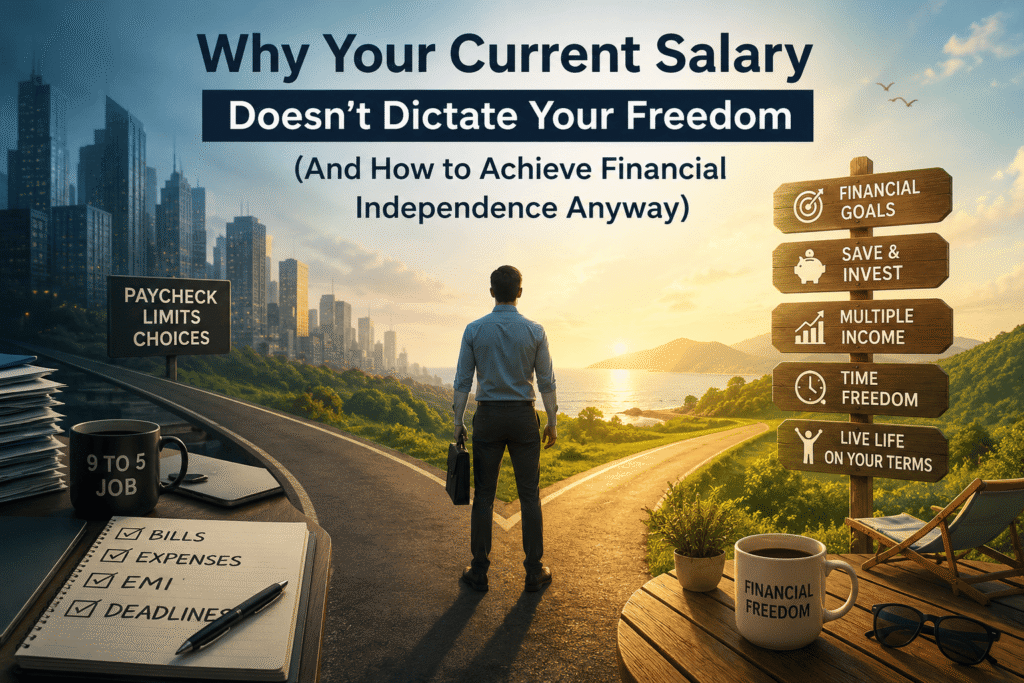
Here is the truth that rarely gets highlighted on glossy magazine covers: Financial independence isn’t about how much you make; it’s about the gap between what you earn and what you spend, and what you choose to do with that gap.
Whether you are earning $40,000, $65,000, or $100,000, the playbook for taking control of your financial destiny remains remarkably similar. You don’t need a corner-office salary to build a life where work is optional. You just need a clear strategy, a willingness to create new income streams, and a shift in how you view money.
Let’s break down exactly how you can build real financial independence step-by-step—no six-figure salary required.
1. Master the Math of Freedom: Income vs. Expenses
Financial independence (FI) simply means having enough passive income or invested assets that you no longer have to work for a paycheck to cover your living expenses.
When people hear this, they immediately focus on the destination—the total net worth number. But the engine that actually drives you there is your savings rate (the percentage of your take-home pay that you save and invest).
Consider two different people:
- Sarah earns $150,000 a year, but because of expensive cars, a lavish apartment, and daily dining out, she spends $140,000. Her savings rate is roughly 6.6%.
- Alex earns $52,000 a year, lives mindfully with roommates, cooks at home, and spends $36,000. His savings rate is roughly 30%.
Mathematically, Alex is significantly closer to financial freedom than Sarah. Why? Because Alex’s low baseline expenses mean he needs a much smaller total nest egg to support his lifestyle forever. Meanwhile, Sarah has built a high-overhead life that requires a massive fortune to maintain.
The takeaway? Stop measuring your financial potential by your gross salary. Focus instead on widening the gap between your earnings and your overhead.
2. Spend on What You Love, Ruthlessly Cut the Rest
Achieving financial independence on a modest salary doesn’t mean eating instant noodles for twenty years and living in total deprivation. That kind of extreme frugality usually leads to burnout—much like crash dieting.
Instead, practice value-based spending.
Sit down with your bank statements from the last three months and ask yourself: What purchases actually brought joy, health, or genuine convenience into my life?
Keep those. In fact, lean into them! If you genuinely love specialty coffee, keep buying it without guilt. But look at the remaining line items—the forgotten subscriptions, the convenience food bought out of stress, the impulse buys on Amazon—and cut them relentlessly.
When you align your spending strictly with your actual values, you free up cash for investments without feeling like you’ve sacrificed your quality of life.
3. Create Your Own Raise: The Power of Micro-Freelancing
Cutting expenses is crucial, but budget optimization has a floor—you can only reduce your spending to zero. Your earning potential, however, has no ceiling.
If you rely solely on your day job, your wealth building moves at the speed of your annual 3% performance review. To accelerate your journey to financial independence, you need to create your own raises through flexible side income.
The key to a sustainable side hustle isn’t trading endless hours for pennies; it’s choosing low-friction services with a low barrier to entry that small businesses desperately need. One of the most accessible areas to break into right now is simple freelance design work.
Why Simple Design Gigs Are Perfect for Beginners
You don’t need a four-year fine arts degree or high-end studio software to help small businesses look professional online. Every single day, thousands of new businesses, Etsy shop owners, local contractors, and podcast hosts launch their ventures. They need basic visual assets, but they don’t have the budget to hire a full-service creative agency charging $5,000 a project.
This is where you come in. You can offer high-value, streamlined creative packages like:
- Social media header graphics and Instagram templates
- Simple digital menus for local cafes
- Brand style kits (selecting complementary color palettes and typography)
- Quick brand identity overhauls and basic logos
By leveraging modern design platforms and an intuitive logo maker, you can quickly generate clean, customized visual concepts and vector mockups for clients in a fraction of the time it used to take. These modern tools allow you to deliver crisp, high-resolution brand assets that look completely professional, even if you’re relatively new to graphic design.
Imagine taking on just two or three small branding projects a month at $150 to $300 each. That’s an extra $500 to $900 a month in direct cash flow. If you take that extra income and funnel 100% of it into your investment portfolio, you can shave years off your path to financial freedom.
4. Put Your Dollars to Work: Automate Your Wealth
Once you’ve created a gap between your expenses and your total income (including your freelance earnings), you need to put those dollars to work. Money sitting in a standard savings account loses purchasing power every year due to inflation.
You don’t need to be a Wall Street stock picker to invest successfully. In fact, simple strategies consistently beat complex ones.
Here is the three-step framework for automated investing:
- Build a Cash Safety Net First: Keep 3 to 6 months of essential living expenses in a High-Yield Savings Account (HYSA). This prevents you from having to sell investments if an unexpected emergency pops up.
- Utilize Tax-Advantaged Accounts: Take advantage of accounts like a 401(k) (especially if your employer offers a matching contribution—that’s free money!) or an Individual Retirement Account (IRA/Roth IRA).
- Invest in Broad-Market Index Funds: Instead of buying individual stocks, invest in low-cost index funds or ETFs that track the broader market (such as an S&P 500 or Total Stock Market index fund). This gives you instant diversification across hundreds of top companies.
Set up an automatic transfer every payday. When investing becomes automatic, you remove emotion from the process and let compounding interest do the heavy lifting over time.
5. The Freedom Mindset: Shifting from Consumer to Owner
Ultimately, financial independence is less about bank accounts and more about psychology. It requires shifting your mindset from being purely a consumer in the economy to becoming an owner.
- Consumers exchange their time for money, and then exchange that money for depreciating assets—clothes, electronics, cars, and gadgets that lose value the second they are purchased.
- Owners exchange their time and skill to acquire or build appreciating assets—index funds, real estate, personal skills, and side businesses that continue to generate income.
When you start viewing every $100 you save or earn freelancing not as “money you can’t spend,” but as “a digital worker that will generate passive dividends for the rest of your life,” your entire relationship with money changes.
Bringing It All Together
Financial independence isn’t a private club reserved exclusively for high earners, tech founders, or inheritance recipients. It is a trainable skill set built on simple, repeatable habits:
- Know your numbers and focus on expanding your savings rate.
- Spend intentionally on things that truly enrich your life.
- Boost your income with flexible skills—like offering quick design services using accessible digital tools—to supercharge your savings pipeline.
- Automate your investments into low-cost index funds and let compound interest work its magic.
You don’t have to overhaul your entire life overnight. Start small. Pick one area to optimize this week—whether that’s setting up a high-yield savings account, auditing your monthly subscriptions, or testing out a simple freelance service.
Your future, financially independent self will thank you for taking that first step today.
What’s the biggest obstacle currently holding you back on your journey to financial independence? Share your thoughts or questions in the comments below!