







If you want a safe method for turning your savings into fixed cash monthly, then the SBI Annuity Deposit Scheme is one of the widely used investment choices in India among retired people, salaried employees, and investors who are not inclined towards market risks. This scheme, which is offered by the largest public sector lender of India, i.e., State Bank of India, is where you can invest a lump sum amount just once and get monthly equal payouts in terms of interest as well as principal for a fixed tenure.
SBI Annuity Deposit Scheme: The annuity deposit scheme has a different design as compared to a normal fixed deposit, in which interest will be paid separately or reinvested, but the principal itself is returned over time along with interest, so it is beneficial for people who do not want to manage another portfolio and get a predictable cash flow.
In this article, we shall be explaining in detail what the SBI Annuity Deposit Scheme is, who can open an account under it, the current interest rate applicable to the deposits made via this scheme, min and max limits on deposit amounts, tenure options available for these deposits as well as tax treatment of payouts from these investments, along with the computation of the monthly annuity amount. We will also analyse this plan against other similar plans and answer some of the popular questions on it to help you ascertain if this is a suitable investment for your objectives.
What Is the SBI Annuity Deposit Scheme?
The SBI Annuity Deposit Scheme is a one-time investment by the depositor as a term deposit scheme that provides monthly payments consisting of both components of principal repayment and interest accrued over the investment period to the depositor in the form of Equated Monthly Instalments (EMIs). This is qualitatively different from an ordinary recurring deposit or a monthly income scheme with a fixed deposit, as the principal amount remains locked till maturity, and this principal will be reduced every month each time the instalment is paid out, akin to working backwards out of a loan EMI.
The structure makes the SBI Annuity Deposit Scheme a great option for senior citizens, retired professionals looking to augment pension income or receive any large & non-periodic sum all at once (for example: retirement benefits, insurance payout or proceeds from sale of an asset) and wish for that sum to keep churning out a fixed monthly cash flow instead of being parked away in a savings account without generating value.
Key Features of the SBI Annuity Deposit Scheme
Having a grasp of the core features of this scheme, which are summarised in the table below, can therefore be very helpful before you open your account.
Key Features of SBI Annuity Deposit Scheme
| Feature | Details |
| Scheme Type | Lump sum deposit with monthly annuity payout |
| Minimum Deposit | Amount such that minimum monthly instalment is Rs. 1,000 |
| Maximum Deposit | No upper limit (subject to bank’s internal guidelines) |
| Tenure Options | 36 months, 60 months, 84 months, and 120 months |
| Interest Rate | Same as applicable term deposit rates for the chosen tenure |
| Payout Frequency | Monthly, on a fixed date |
| Premature Withdrawal | Allowed with applicable penalty |
| Loan/Overdraft Facility | Available against the deposit |
| Nomination Facility | Available |
| Eligible Depositors | Resident individuals, joint holders, and senior citizens |
Read Also: Army Clerk Salary 2026
Eligibility Criteria for the SBI Annuity Deposit Scheme
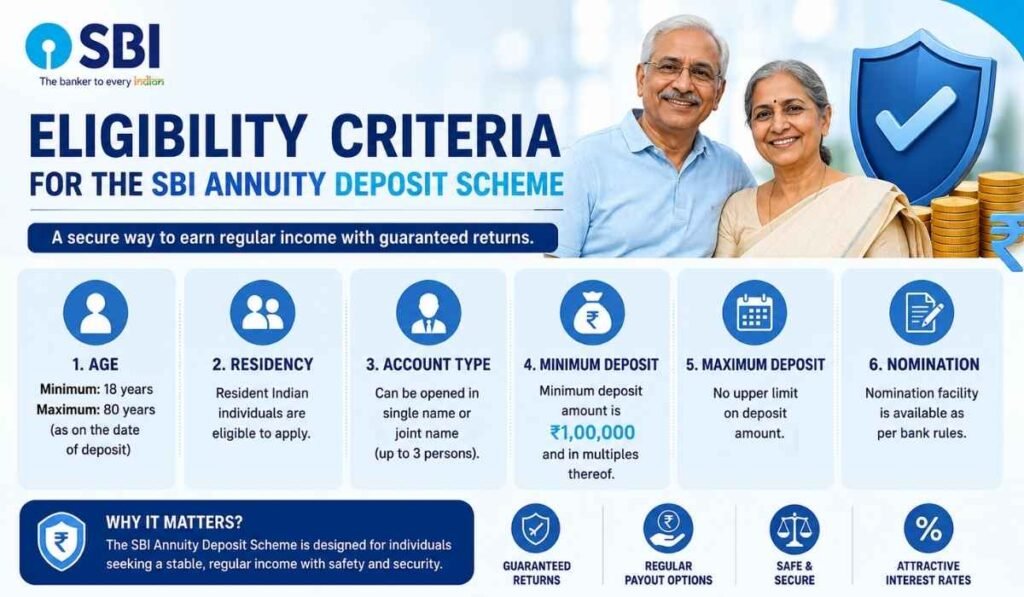
An individual can open an account under the SBI Annuity Deposit Scheme, either singly or jointly with any other person. They also have a special rate applicable for senior citizens and, in many cases, the interest rate offered on these deposits to senior citizens is slightly higher than what is available for regular fixed deposits. NRIs, too, are allowed to invest via NRO accounts, but with a slight tweak in the payout rules. There is no ceiling on age for the account, thus making it an ideal banking product for senior depositors to plan a steady source of income in their twilight years.
How the SBI Annuity Deposit Scheme Works
Under the SBI Annuity Deposit Scheme, upon depositing a lump sum, the bank computes an amount that becomes a fixed monthly instalment for you based on your deposit amount, applicable interest rate, and tenure chosen. A part of the principal amount and interest charged on the outstanding balance for that month are included in each monthly instalment. Since the outstanding principal decreases as months go by, the interest element of each instalment tapers off gradually while that of principal grows; however, the overall instalment amount remains unchanged over the course of its tenure.
Mathematically, this looks a lot like how banks calculate EMI for loans only; the money flow is reversed. In this segment, the bank pays you monthly, and at the end of the tenure, the whole principal + interest is paid out in total, leaving nothing in your account.
Interest Rates Under the SBI Annuity Deposit Scheme
In the SBI Annuity Deposit Scheme, interest rates are the same as those applicable to the bank’s current term deposit rate for the tenure chosen. Due to their periodic reconfirmation based on the monetary policy of the Reserve Bank of India as well as the liquidity position with respect to those banks, these rates should be checked time and again, preferably from the State Bank of India official website or by visiting a branch before account opening. Under this scheme, elderly citizens usually receive a higher interest rate over the standard interest rate, generally ranging from 0.50 percentage points.
Indicative Tenure-wise Structure of SBI Annuity Deposit Scheme
| Tenure | Payout Type | Suitable For |
| 36 months (3 years) | Monthly principal + interest | Short-term income needs |
| 60 months (5 years) | Monthly principal + interest | Medium-term planning |
| 84 months (7 years) | Monthly principal + interest | Long-term steady income |
| 120 months (10 years) | Monthly principal + interest | Retirement income planning |
Read Also: 2.5 LPA In Hand Salary
Minimum and Maximum Deposit Limits
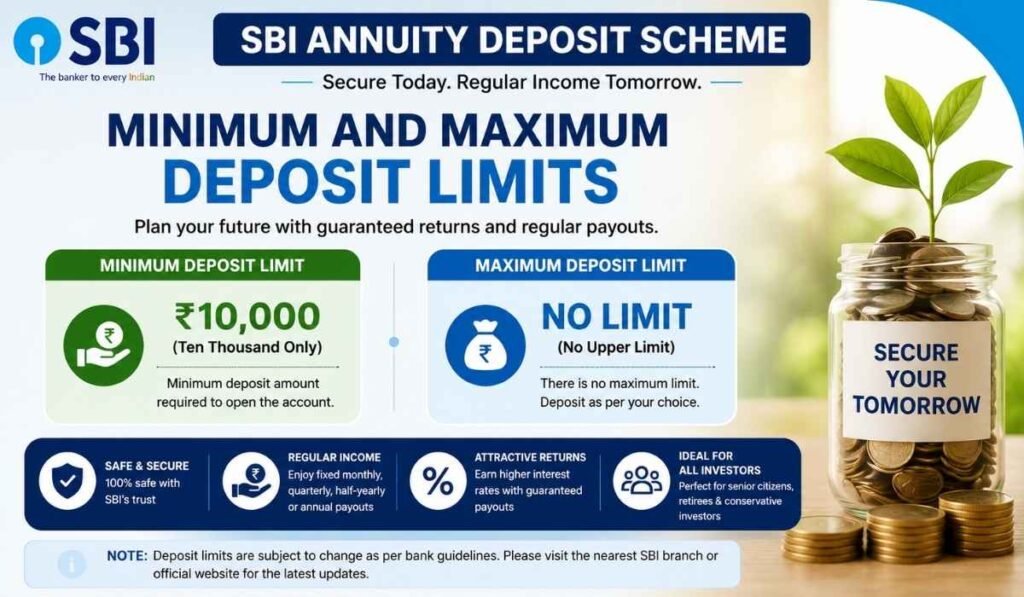
The minimum amount under the SBI Annuity Deposit Scheme depends on the fact that the monthly instalment must not be less than Rs. 1,000. Therefore, the minimum lump sum investment that you can make differs from one person to another because it is based on an interest rate and a tenure at the time of making your deposit. This scheme has no maximum limit, so high-net-worth individuals and retirees with large retirement corpus can invest in a big way as well and earn higher monthly payouts accordingly.
Illustrative Monthly Payout Example (for reference only, actual rates may vary)
| Deposit Amount | Tenure | Approx. Interest Rate | Approx. Monthly Payout |
| Rs. 5,00,000 | 60 months | 6.75% p.a. | Rs. 9,800 approx. |
| Rs. 10,00,000 | 60 months | 6.75% p.a. | Rs. 19,600 approx. |
| Rs. 10,00,000 | 120 months | 6.75% p.a. | Rs. 11,400 approx. |
| Rs. 20,00,000 | 84 months | 6.75% p.a. | Rs. 30,500 approx. |
Note: These numbers are for example only. The amount of monthly payouts under the SBI Annuity Deposit Scheme would vary depending on the interest rate at which deposits are made on the date of deposit and should be verified with the bank, or you can use an official annuity calculator before making your investment.
Tax Implications of the SBI Annuity Deposit Scheme
Interest portion of each monthly instalment realised under SBI Annuity Deposit Scheme is charged to tax as income from other sources, according to the depositor’s relevant income tax slab. If the interest component exceeds the limit specified under the Income Tax Act, TDS or Tax Deducted at Source is deducted by banks on that interest. Default Question: By submitting Form 15H, senior citizen depositors can avoid TDS deduction if their total income is below the taxable limit. Other eligible depositors can submit Form 15G. Note that the scheme only has tax liability on the interest payment and not the principal repayment.
Premature Withdrawal and Loan Facility
In case of the SBI Annuity Deposit Scheme, if a customer makes a premature withdrawal on depositing an annuity deposit, then it would pay a penalty on the interest rate as in case of the partial shift with SBI regular fixed deposits. Against this deposit, a loan or overdraft facility is also available, which an individual can take in case of temporary need for money without breaking the deposit. The exact percentage for the loan of such kind available and the interest rates applicable on it should be verified with the bank at the time when needed.
How to Open an Account Under the SBI Annuity Deposit Scheme

Here is how it works: it can be easily opened either through the branch, and also under this scheme, in some cases, it will also be possible to open an account via SBI’s internet banking platform, which will depend on the existing relationship of the account holders with SBI.
Read Also: Forest Guard Salary: Pay Scale, In-Hand Salary & Benefits
Step-by-Step Process to Open SBI Annuity Deposit Scheme
| Step | Action |
| Step 1 | Visit your nearest SBI branch or check eligibility via net banking |
| Step 2 | Submit KYC documents (PAN, Aadhaar, address proof) |
| Step 3 | Decide on the lump sum amount and preferred tenure |
| Step 4 | Fill in the annuity deposit application form |
| Step 5 | Provide nomination details and payout bank account |
| Step 6 | Deposit the lump sum amount |
| Step 7 | Start receiving monthly payouts as per schedule |
Advantages and Limitations of the SBI Annuity Deposit Scheme
This scheme, like any other financial product, has its own pros and cons, which potential investors should carefully evaluate.
Pros and Cons of the Scheme
| Advantages | Limitations |
| Predictable monthly income | Interest is fully taxable |
| Backed by a government-owned bank | Principal reduces over time, unlike a regular FD |
| Flexible tenure options | Premature withdrawal attracts a penalty |
| Loan facility against deposit | Returns similar to regular FD, not inflation-beating |
| Suitable for retirees and senior citizens | Minimum deposit requirement may not suit small savers |
Who Should Consider the SBI Annuity Deposit Scheme?
This plan works best for retirees who have received a retirement benefit in a lump sum and want their monthly income without being linked to the market, essentially eliminating all risk. This is also beneficial for those who have received a sudden sum, like through inheritance or sale of immovable property, and will want to safeguard capital through an instrument that is backed by a bank rather than a market-linked one like an MF or the stock market. But as the scheme’s primary aim is to ensure income stability instead of wealth creation, younger investors with a longer time horizon and higher risk appetite may be better off in equity-linked instruments that deliver better long-term returns.
Comparison with Other Similar Schemes
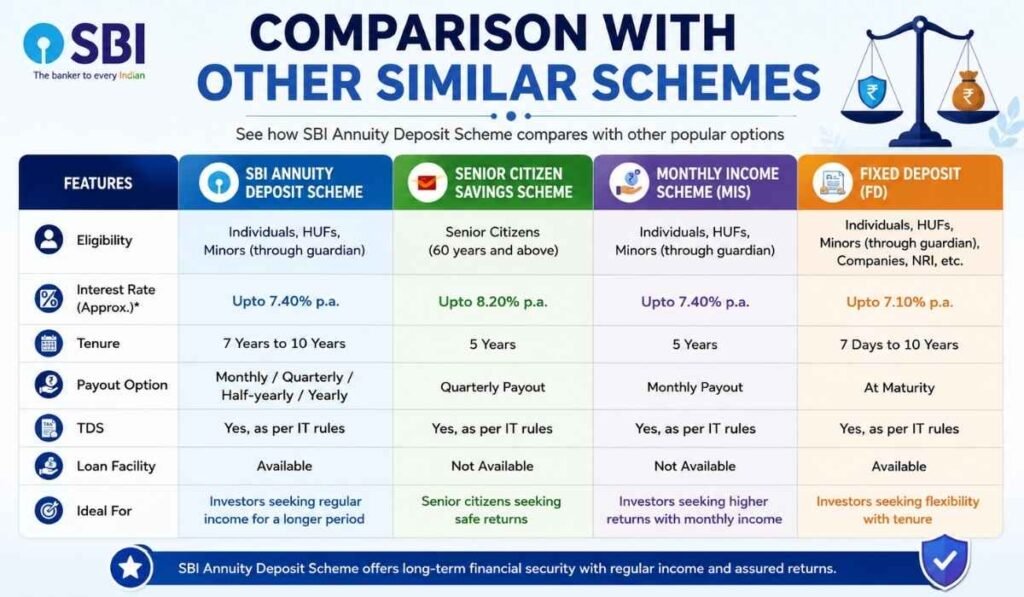
The main difference between a Monthly Income Scheme or regular fixed deposit with monthly payout and this scheme is how the principal is treated. Unlike a normal FD, where the principal is tied up and interest is paid monthly, in this structure, both principal and interest are returned together every month, resulting in the balance of your account going towards zero by maturity. That makes it a better fit for a person who wants his full investment, principal and interest, back together over a period of time, not just the interest.
Read Also: Medical Assistant Salary in 2026
Conclusion
This plan is a reliable low-risk investment for anyone who wants a fixed, short-term, predictable monthly income from a single lump sum deposit. The tenures can be anything from three years to 10 years, supported by the largest public sector bank in India (State Bank of India). As an added advantage for senior citizens, this scheme is still one of the most preferred schemes for conservative investors or retirees. As an investor, you can check the prevailing interest rates and use the bank’s annuity calculator to arrive at its monthly projection, and meet a representative or financial advisor to assess if the scheme fits your entire financial framework.
Frequently Asked Questions (FAQs)
Q1. What is this scheme?
It is a term deposit scheme offered by the State Bank of India where a lump sum deposit is repaid through equal monthly instalments comprising both principal and interest over a fixed tenure.
Q2. What is the minimum amount required to open this account?
The minimum deposit is the amount required to generate a monthly instalment of at least Rs. 1,000, which varies based on tenure and prevailing interest rates.
Q3. What tenure options are available under this scheme?
The scheme offers four tenure options: 36 months, 60 months, 84 months, and 120 months.
Q4. Is the interest earned under the scheme taxable?
Yes, the interest component of each monthly instalment is taxable as per the depositor’s income tax slab, and TDS is deducted if it exceeds the prescribed threshold.
Q5. Can senior citizens get a higher interest rate under this scheme?
Yes, senior citizens are generally eligible for an additional interest rate benefit, similar to regular fixed deposits.
Q6. Can I withdraw my deposit before the tenure ends?
Yes, premature withdrawal is allowed, but it attracts a penalty on the applicable interest rate.
Q7. Is a loan facility available against this deposit?
Yes, depositors can avail a loan or overdraft facility against their deposit under this scheme.
Q8. How is the monthly payout calculated?
The monthly payout is calculated using an annuity formula that factors in the deposit amount, applicable interest rate, and chosen tenure, similar to a reverse EMI calculation.
Q9. Can NRIs invest in this scheme?
NRIs can invest through NRO accounts, though certain payout and repatriation rules may apply differently compared to resident Indians.
Q10. Is there a maximum limit on how much I can deposit?
There is no specific maximum limit, allowing investors to deposit large sums based on their financial needs and the bank’s internal guidelines.

Yashika is the dedicated content writer and salary research author at TheMonthlySalary.com. She specializes in creating clear, helpful, and easy-to-understand content about monthly salary, in-hand pay, salary calculators, career growth, and salary updates. Her goal is to simplify salary-related topics for employees, job seekers, students, and working professionals. Through well-researched guides and practical insights, Yashika helps readers make smarter career and financial decisions.