






If you are preparing for state-level revenue department recruitment exams, the village accountant salary structure is one aspect that you all should know about. The village accountant (known as Patwari in some regions, Karnam or Talati in others, and VRO (Village Revenue Officer) in other states) is a government employee responsible for managing land records, collecting revenue, and carrying out rural administrative work at the ground level. Millions of candidates apply for this post across states in India through state public service commissions and subordinate services selection boards every year, which makes this salary data one of the most searched on the Internet by Government job seekers.
This article details the Village Accountant Salary structure of this post, in hand pay after deductions and allowances, job profile for East India Company/IBPS & other PSUs Bank clerk, promotion prospects to move up from the entry level bank clerk role to supervisor roles, required skillset for this post along with frequently asked questions so that whenever aspirants have either applied or received offer later they get an one point reference source.
Who Is a Village Accountant
A state government official who is posted in villages or at the revenue circle level. The post is part of the Revenue Department of the respective state governments and is one of the oldest administrative positions in India, right from pre-independence days when all land revenue systems were critical to governance. The responsibilities range, mediated by the state, but broadly center on land records, revenue collection of taxes, and implementation of rural welfare schemes.
Many candidates are interested in the remuneration, as to whether it will make the job financially worthwhile given the responsibilities and rural location prior to applying, as pay really determines how appealing a position will be when compared to other state government bodies. Now, this is where the village accountant salary plays an important role in selecting candidates who have multiple options to compare state-level notifications together.
Recruitment and Eligibility
Various State Level Bodies such as Kerala Public Service Commission, Karnataka Public Service Commission, Maharashtra Village Appointed board, village accountant vacancies were released by various state level boards like Telangana State Public Service Commission ser grazing fee for hay turmeric fibre along with other posts, Andhra Pradesh Public Service Commission, Tamil Nadu Public Service Commission, and so on. A minimum qualification is generally a bachelor’s degree from any reputable university, and in many states, basic computer literacy certification.
The age limit varies from 18 years to 35 years, while the reserved candidates, including SC, ST, OBC, and PwD candidates, are given relaxations in age as per state government guidelines. The selection process includes a written exam on general studies, maths, and reasoning, followed by the revenue law of the state ( this second round occurs in some states), and then a computer test along with document verification.
During document verification, candidates are also required to provide caste certificates, domicile proof, and educational mark sheets. After being selected, a recruit naturally wants to know about the pay band and gross compensation, and this is where familiarity with how the salary matrix for the village accountant works comes in handy when allowances and posting preferences are discussed.
Village Accountant Salary Structure
As the revenue department recruitment and pay scales in India are a state subject, the village accountant salary will depend on the pay matrix or pay band as applicable in different states of India. The basic starting salary of this post is in the range of Rs. 20,000 to 35,000 per month on average, depending upon the recommendation by the state pay commission trend. With dearness allowance, house rent allowance, and other allowances, the gross pay at the entry level is on the higher side, between Rs. 25,000-45,000 per month.
States implementing more pay matrices like those recommended under a central Seventh Pay Commission tend to have us provide a higher gross figure than in states classified against old pay scales. These pay figures are typically two or three rounds of pay revision old, only to be left somewhere behind the state’s own pay commission report, compared to its second capital except once in five years-ish, so treat the numbers below as indicative at best.
Read Also: Postal Assistant Salary: Pay Scale, In-Hand Salary, Allowances
Village Accountant Salary Across States (Approximate, 2026)
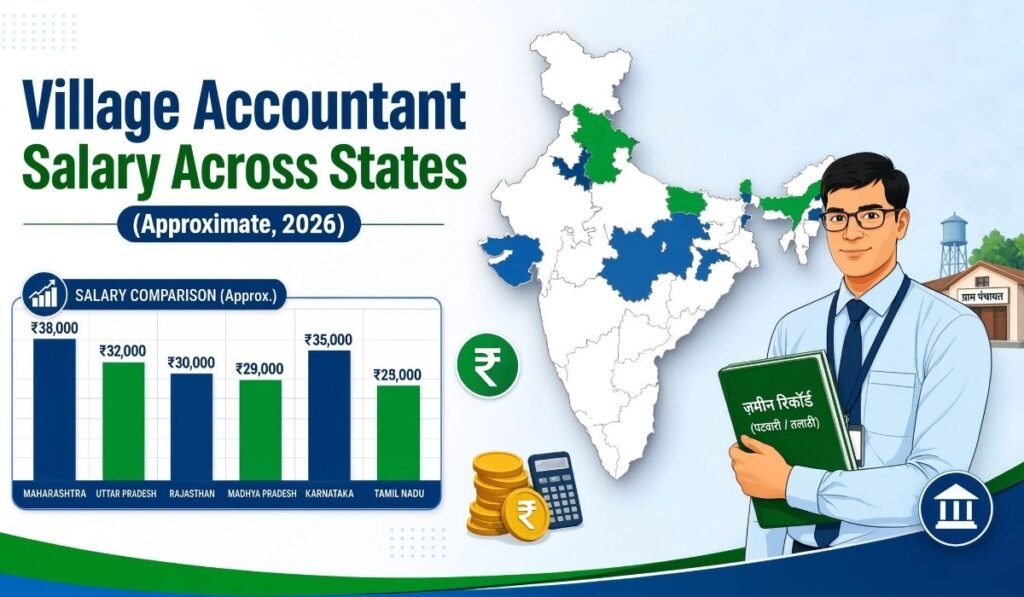
| State | Pay Scale (Basic) | Gross Monthly Salary (Approx.) |
| Karnataka | Rs. 21,400 – Rs. 42,000 | Rs. 32,000 – Rs. 40,000 |
| Telangana | Rs. 22,460 – Rs. 66,330 | Rs. 34,000 – Rs. 42,000 |
| Andhra Pradesh | Rs. 21,230 – Rs. 63,010 | Rs. 33,000 – Rs. 41,000 |
| Tamil Nadu | Rs. 19,500 – Rs. 62,000 | Rs. 30,000 – Rs. 38,000 |
| Maharashtra | Rs. 25,500 – Rs. 81,100 | Rs. 36,000 – Rs. 44,000 |
| Gujarat | Rs. 19,900 – Rs. 63,200 | Rs. 29,000 – Rs. 37,000 |
| Rajasthan | Rs. 20,800 – Rs. 65,900 | Rs. 31,000 – Rs. 39,000 |
| Madhya Pradesh | Rs. 19,500 – Rs. 62,000 | Rs. 28,000 – Rs. 36,000 |
| Bihar | Rs. 19,900 – Rs. 63,200 | Rs. 27,000 – Rs. 35,000 |
| Uttar Pradesh | Rs. 21,700 – Rs. 69,100 | Rs. 30,000 – Rs. 38,000 |
Disclaimer: Figures are indicative, as actual salaries vary by district/posting and according to state pay commission revisions. Job seekers must always cross-check the official notification for their respective state recruitment board before proceeding to fill out the application form, as the village accountant salary is subject to change with every new pay commission cycle.
Components of the Salary
The gross salary per month, however, is not just a single numerical value but rather the sum of many different values that together comprise your total Village Accountant Salary. These components include:
- Pay Level: This is the fixed element determined based on the applicable state pay matrix, providing the basis for calculating all other allowances.
- Dearness allowance (DA): The portion of basic pay that is revised periodically to counterbalance inflation has a huge bearing on the final take-home number.
- House Rent Allowance (HRA): Depends on posting; HRA is generally lower in rural postings compared to urban/semi-urban.
- TA: Travel Allowance covers local travel expenses incurred while visiting the field in connection with land surveying and record verification assignments.
- Special Rural Allowance: Certain states provide a special allowance for those posted in remote areas, i.e., far away villages&
- Medical Allowance: A fixed or reimbursement component, typically covering healthcare expenses.
- ● Uniform or Kit allowance: A few states provide a nominal annual kit allowance for commonplace field-duty items (stationery and recordkeeping registers).
Sample Salary Breakup for an Entry-Level Village Accountant
| Component | Approximate Amount (Rs./month) |
| Basic Pay | 21,400 |
| Dearness Allowance | 4,600 |
| House Rent Allowance | 3,200 |
| Travel Allowance | 1,200 |
| Special Rural Allowance | 800 |
| Medical Allowance | 500 |
| Gross Salary | 31,700 |
| Deductions (PF, NPS, Insurance) | 3,200 |
| Net In-Hand Salary | 28,500 |
Read Also: DevOps Engineer Salary in 2026
In-Hand Salary After Deductions
Statutory deductions like Provident Fund or National Pension System contributions, professional tax, and group insurance premiums usually reduce gross pay by 10-15%. Through gross payment of Rs.32,000/- usually the net take-home comes down to around Rs 27,000 /-to Rs 29,000/-, depending on the state deduction rules and whether or not the employee had opted for any voluntary savings schemes. One of the reasons why recruitment adverts quote a headline village accountant salary figure that looks significantly better than what actually appears in your bank each month is this divide between gross and net.
Job Profile and Responsibilities
Aside from gross pay, it is good to know exactly what hands-on work is required so that compensation is related to the scope of work assigned. Typical duties include:
- Keeping up-to-date land revenue record (khatauni, khasra, or respective document)
- QoP for checking land ownership, mutation entries
- Collecting land revenue and other government dues from the villagers.
- Assisting in implementing rural welfare and government schemes
- Compensatory surveys in natural disasters
- Supporting the Tehsildar or Revenue Officer during inspections
- Keeping a system of birth, death certificates, and caste certificates at the village level
- Coordination with Panchayat officials regarding local development works
- Periodic reporting on crop patterns and land use for the district administration
Considering this very large range of activities, a lot of aspirants consider the entry-level village accountant salary to be low because of this vast job profile, but also note that the job security and rural exposure are often used as justifying parameters.
Documents Required for Recruitment and Joining

Candidates shortlisted for this post are usually asked to submit a specific set of documents at the time of document verification and again at the time of joining. These typically include:
● Original mark sheets and passing certificates for the qualifying degree
● Date of birth proof such as a Class 10 certificate or birth certificate
● Caste, category, or reservation certificate, where applicable
● Domicile or residence certificate for the concerned state
● Computer literacy or typing certificate, if mandated by the recruiting state
● Character certificate from the last educational institution attended
● Medical fitness certificate issued by an authorized government doctor
● Recent passport-size photographs and a valid identity proof such as Aadhaar
Missing or incomplete documentation is one of the most common reasons candidates face delays in appointment orders, so aspirants are advised to keep both original and photocopied sets ready well before the verification date. Getting this paperwork in order early also means recruits can focus on understanding their pay slip and allowance structure from the very first month, rather than chasing corrections to their service record.
Allowance Variation by Posting Type
The allowances like HRA and other allowances are usually categorized on the basis of the type of area where an employee has been posted as part of his/her posting. Generally, rural postings (accounting for the majority of this post) attract the lowest percentage of HRA, but are sometimes effectively compensated through a separate, explicitly defined rural or remote-area allowance instead. Most states follow a three-tier classification considered too broad, as urban, semi-urban, and rural.
Read Also: MTS Havaldar Salary 2026
Typical HRA Classification by Posting Area
| Posting Area Type | Typical HRA (% of Basic Pay) | Additional Allowance |
| Urban / District HQ | 16% – 24% | Nil |
| Semi-Urban | 10% – 16% | Occasional conveyance allowance |
| Rural | 6% – 10% | Special rural or remote-area allowance in some states |
Skills Required for the Role
The other expectations from a village accountant include. grooming such as record-keeping habits, basic computer knowledge for digitized land records, comfort with the local language and dialects to connect with the villagers/tasks, and ability to work scent in low supervision in a rural space. As revenue collection and measuring land both depend on exact numbers, numerical accuracy is a key requirement. These softer, more technical skills, combined with the relevant salary bracket, together shape how rewarding that role feels in practice above and beyond the headline figure.
Career Growth and Promotion
However, one of the reasons why candidates are drawn to this position despite its relatively low starting salary is the career advancement it affords in the long run. A village accountant may, in the meantime, be promoted to Revenue Inspector, Deputy Tehsildar, and then Tehsildar, which has a pay scale higher than the initial pay scale by multiple factors. Promotions are usually based on seniority, departmental exams, and vacancies in the state revenue hierarchy. Although the starting village accountant salary on paper looks less than impressive, one reason for this entry point to be synonymous with upward mobility is that most senior revenue officials across states in India have begun their careers as village accountants.
Promotion Hierarchy and Approximate Pay Comparison
| Post | Approximate Basic Pay Range |
| Village Accountant | Rs. 20,000 – Rs. 35,000 |
| Revenue Inspector | Rs. 35,000 – Rs. 55,000 |
| Deputy Tehsildar | Rs. 47,000 – Rs. 70,000 |
| Tehsildar | Rs. 56,000 – Rs. 85,000 |
Factors Affecting the Pay
The individual employee’s salary for the village accountant will depend upon many factors:
- Posting State: Pay scales are entirely different because of independent state pay commissions.
- Pay Commission Revisions – The states that are implementing the recommendations of the newer pay commission tend to offer more revised pay.
- Posting Location- Remote Area/Hilly Area postings may carry packing benefits.
- Duration of service: The basic pay component increases little by little with annual increments.
- Allowances affected: The amount of HRA determines the net amount you take home.
- Clearing DDs exams: Once you clear the internal departmental promotional qualifying exams, it becomes easier to get into a higher pay band.
Pros and Cons of the Role

Entry-level compensation is lower than that of other prestigious civil service jobs, but the position comes with tenure, pension or NPS benefits, and a straightforward promotion ladder. However, the bureaucratic pressure that comes during land disputes with state/central power, posting in rural areas, and much lower pay scales at entry-level jobs than their counterparts are some of the main ills listed by many.
Compared to the basic Village Accountant Salary, Candidates consider these factors along with other benefits such as (Government jobs they obtain through village accountants come at a short term salary but overall job stability comes at long-term gaining pension benefits and finally it certainly tips the scales in favour of steady employment over modest entry level pay; Particularly true of rural postings since this too is correlated when compared to urban salaries of states since villages provide inherently low cost of living)
How to Prepare for the Exam
Direct recruits who do not require a high salary package should concentrate on preparation in areas like general knowledge, relevant vocabulary by state, basic math and reasoning skills, as well as computer proficiency (Some states recently introduced a Computer Proficiency Test as part of the selection process). Since recruitment cycles differ year-on-year, and even more so the actual pay structure, an aspirant must read previous years’ question papers from time to time, as well as keep up with the latest updates on notifications by the state government. Mailing lists for state recruitment boards should also be joined by aspirants, or notification portals should be checked regularly, since changes in eligibility may not necessarily come with ample time.
Read Also: Food Inspector Salary in India 2026
Conclusion About Village Accountant Salary
The village accountant job post is a stable entry-level post for the state revenue administration, even though it can be counted as one of the low-salaries government jobs list in India, but the promotion opportunities are obviously there, and most importantly, pension benefits are included, which are not availed in many private-sector jobs, so being a permanent employee implies that you will definitely secure your future.
Since pay commission and rate of allowances change from time to time, actual and updated pay figures must always be referred to the latest official notification released by the corresponding state public service commission. If one is properly prepared and has the knowledge of the payment structure, one can make this important choice about whether or not they want to follow this career path in rural administration.
Frequently Asked Questions
Q1. What is the District accountant salary in India on average?
Typical starting Village Accountant Salary in India is between Rs. 25,000/- and Rs.45,000/- per month, depending on the state of posting and relevant pay commission.
Q2. Read also Indian Women Cricketer Salaries Details; What does a village accountant earn in the highest-paying state?
Between larger states, the updated pay matrices of Maharashtra and Telangana currently provide comparatively higher gross numbers; however, this can differ by posting and allowance status.
Q3. Am I trained till Oct 2023? What is a village accountant in the permanent government job?
Yes, it is a permanent state government job; pension or NPS benefits are also available, and jobs in the revenue department have good job security and clear promotion paths for village accountants.
Q4. Are the HRA and DA included in the salary?
Yes, gross includes basic plus dearness allowance + house rent allowance + travelling allowance and other allowances as provided by the state rules.
Q5. Followings is promotion after the village accountant?
A village accountant may be further elevated to that of Revenue Inspector, then Deputy Tehsildar, and finally Tehsildar with each level corresponding to a higher pay scale.
Q6. What is the in-hand salary calculation?
From the gross monthly salary, deductions made are statutory, like PF or NPS contributions, professional tax, insurance premiums, etc., and the amount left is called in hand salary.
Q7. Is there a difference between male and female candidates for village accountant?
No, the male and female village accountant of the same state and pay level is given similar basic pay and allowance based on post, as per the Pay Grid, not by gender
Q8. Do you get an annual increment as a village accountant?
Yes, the majority of states offer around a 3 percent increase annually on the basic pay component, as per the standard state government service rule.

Prashant Kumar is the dedicated content writer and salary research author at TheMonthlySalary.com. He specializes in creating clear, helpful, and easy-to-understand content about monthly salary, in-hand pay, salary calculators, career growth, and salary updates. My goal is to simplify salary-related topics for employees, job seekers, students, and working professionals. Through well-researched guides and practical insights, Prashant helps readers make smarter career and financial decisions.