







For any professional looking to pursue a career in food safety and public health, the food inspector salary is one of the most important aspects. Food inspectors help protect consumers by overseeing food establishments and making sure they follow appropriate health and safety guidelines.
Now, if you are considering a career as a Food Inspector or want to know how much you can expect out of this profession, here is a complete overview with details about food inspector salary in India at various levels, factors that influence the earnings and advancement for these professionals.
What is a Food Inspector?
So, before we get into the food inspector salary information, let us first look at what exactly a food inspector is. Food inspectors are regulatory or quality professionals involved in carrying out inspections of the food manufacturing units, restaurants, markets and other food service firms. They investigate complaints, collect samples and make reports to ensure food safety laws are being followed. This profession is best suited for people with an interest in public health and obedience to rules and regulations.
Food Inspector Salary: Overview
Food Inspector Salary varies from Government to private, experience, qualification and area. Let us start dissecting the different salary structures.
Government Food Inspector Salary
Government food inspectors are generally divided into two main types:
- State Health Department Food Inspectors
- Municipal Corporation Food Inspectors
The salary of a Food inspector works on fixed scales and increments after a certain period in the government sector.
Food Inspector Salary by Experience Level
Since experience is one of the parameters deciding the food inspector’s salary. Here’s how earnings typically progress:
Entry-Level Food Inspector Salary
The food inspection salary for freshers joining government roles as food inspectors is ₹21,000 to ₹28,000 each month. This is the basic salary along with Dearness Allowance (DA) and other allowances. Most Basic positions need a degree in food science, biology, chemistry or nutrition.
Mid-Level Food Inspector Salary
As justifiable, it climbs fairly high when they have experience of 5-10 years, compared to the food inspector’s salary. Food inspectors at the mid-level are paid from ₹35,000 to ₹45,000/month. Inspectors may serve in supervisory roles, and may participate in training less-experienced staff at this stage.
Senior Food Inspector Salary
Senior food inspectors having an experience of more than 15 years can get a food inspector salary between ₹50,000 and ₹65,000. Few upper-level posts even go up to ₹70,000, depending upon promotion and other certifications.
Food Inspector Salary Across Indian States
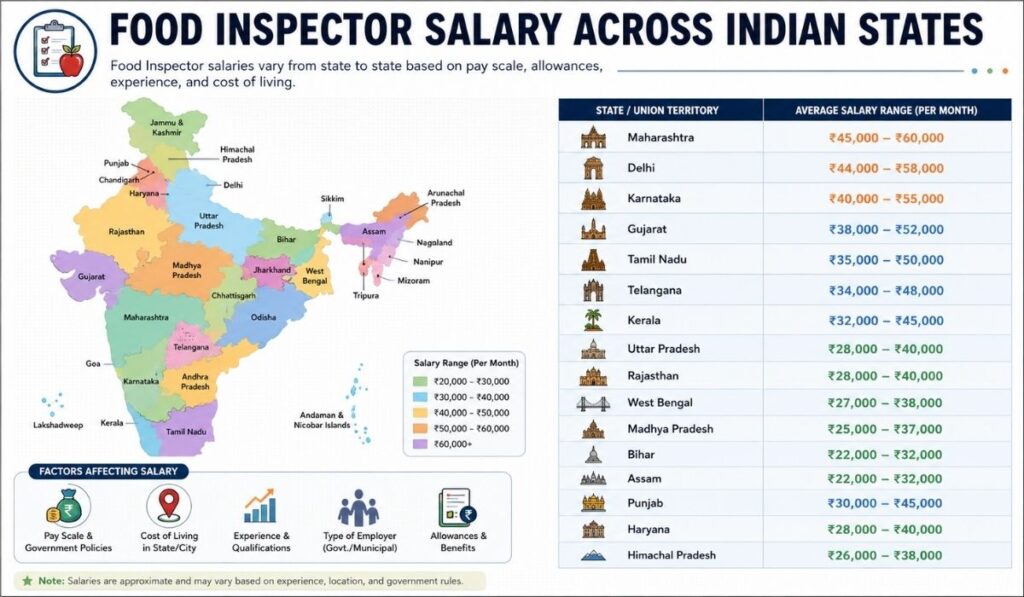
Due to different economic conditions and budget allocations for food inspection, the salary you will receive as an inspector varies significantly from state to state. Here’s a state-wise breakdown:
| State | Entry Level (Monthly) | Mid-Level (Monthly) | Senior Level (Monthly) |
| Maharashtra | ₹23,000 – ₹26,000 | ₹38,000 – ₹45,000 | ₹55,000 – ₹68,000 |
| Delhi | ₹24,000 – ₹27,000 | ₹40,000 – ₹48,000 | ₹60,000 – ₹72,000 |
| Karnataka | ₹21,000 – ₹25,000 | ₹35,000 – ₹42,000 | ₹50,000 – ₹62,000 |
| Tamil Nadu | ₹22,000 – ₹26,000 | ₹36,000 – ₹44,000 | ₹52,000 – ₹65,000 |
| Uttar Pradesh | ₹20,000 – ₹24,000 | ₹33,000 – ₹40,000 | ₹48,000 – ₹58,000 |
| West Bengal | ₹19,000 – ₹23,000 | ₹32,000 – ₹39,000 | ₹46,000 – ₹56,000 |
| Punjab | ₹21,000 – ₹25,000 | ₹35,000 – ₹42,000 | ₹50,000 – ₹60,000 |
| Rajasthan | ₹20,000 – ₹23,000 | ₹33,000 – ₹38,000 | ₹46,000 – ₹54,000 |
Read Also: 25 LPA In Hand Salary in India: Monthly & Take-Home Salary
Food Inspector Salary Components
A food inspector’s salary consists of many things apart from the basic pay. These components have to be understood to find total earnings:
Basic Components of a Food Inspector’s Salary
- Basic Pay: The essential part of the food inspector’s salary, consisting of basic pay, is between ₹18,000 – ₹22,000 approx for freshers.
- Dearness Allowance (DA): This is provided to neutralise the effect of inflation and normally represents 12-17% of a food inspector’s pay. This amount is based on directives from the government and is increased at regular intervals.
- House Rent Allowance (HRA): Between 8-27% of the basic pay based on the class of city. This is an important part of the food inspector’s salary.
- City Compensatory Allowance (CCA): An additional city compensatory allowance is given for metropolitan areas, which varies between ₹800 and ₹2,500 per month, which will further enhancing the food inspector’s salary.
- Special Allowance: Special Allowance is a fixed monthly allowance, usually ₹3,000–₹5,000, offered along with the food inspector’s salary package.
Private Sector Food Inspector Salary
The food inspector’s salary in the private sector can vary widely. Food inspectors are employed through private organisations, either at the level of private companies, food processing industries or quality assurance firms. The salary of a private sector food inspector normally varies as follows-
- Entry Level: ₹25,000 – ₹35,000
- Mid Level: ₹40,000 – ₹55,000
- Senior Level: ₹60,000 – ₹85,000
Some private sector roles also provide added incentives, such as performance bonuses, incentive schemes and training opportunities to enhance the base food inspector wage.
Food Inspector Salary and Benefits
Aside from the monthly food inspector salary, government employees receive some perks:
- Other Perks that go toward the total earnings
- Government Food Inspector: Job Description and Salary Benefits of a Government Food Inspector.
- Using data till October 2023: Inspectors whose services are completed in 20 years take home a pension equal to nearly half of their last pay drawn.
- Medical Advantages: Full medical coverage and the family of government food inspectors represent an important bonus in increasing the overall package salary for food inspectors.
- Annual bonus and gratuity: The lifetime value of an annual performance bonus as well as good-sized pension benefits.
- Leave Benefits: Paid leave (annual, sick, and casual leave) can be accrued by employees.
- Housing Benefits: Few states provide homes for the food inspectors, which ultimately affects the overall food inspector salary in an effective way.
Factors Affecting Food Inspector Salary
Several factors directly determine the food inspector salary that a person earns:
Educational Qualifications
Graduates with a Master`s in Food Science, Public Health or related topics are likely to get a better entry position on the food inspector pay scale.
Certifications and Specialisations
Various certifications, such as ISO certification and HACCP (Hazard Analysis and Critical Control Points), apart from food safety management, boost food inspector salary and promote quicker advancement in the career.
Performance and Appraisals
Re-evaluations are conducted on a constant basis, leading to faster increments and bonuses, thus enhancing the total food inspector salary.
Location and Posting
The food inspector’s salary in developed and tier-1 cities is on the higher side compared to other tier-2 or less developed countries. This is because of the greater cost of living, and also provides special allowances.
Seniority and Promotions
Promotions to senior inspector, supervising inspector or administrative roles come with noticeable increases in the food inspector’s pay.
Read Also: Manav Sampada Login 2026: Employee Portal Access
Career Advancement and Salary Growth
A food inspector’s salary is a career, and the first thing you need to understand is how your career will progress through time. The typical advancement path includes:
- Food Inspector: Basic pay with food inspector salary included
- Senior Food Inspector: Oversees junior personnel, coordinates inspection
- Supervising inspector: oversees several inspection teams
- Food Safety Officer: (administrative role and policy making)
- Chief Food Officer: This person leads the food safety division
Although the food inspector’s salary varies with years of experience, each promotion level offers a 20-40% hike, and an extremely high senior administrative position may earn ₹1,00,000+ per month.
Food Inspector Salary Comparison: Government vs Private Sector
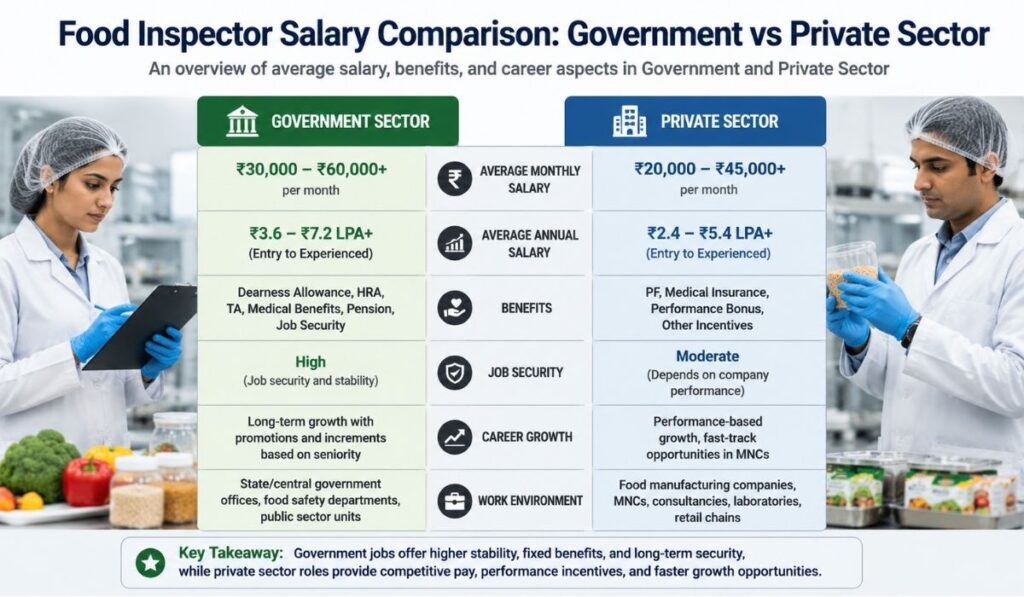
| Aspect | Government | Private Sector |
| Entry Level Salary | ₹21,000-₹28,000 | ₹25,000-₹35,000 |
| Mid-Level Salary | ₹35,000-₹45,000 | ₹40,000-₹55,000 |
| Senior Level Salary | ₹50,000-₹70,000 | ₹60,000-₹85,000 |
| Job Security | Highly Secure | Moderate |
| Pension | Yes | Limited/Rare |
| Growth Rate | Slow but Steady | Fast |
| Bonus Structure | Fixed | Performance-based |
How to Increase Your Food Inspector Salary
Professional Development
Achieving further certifications in food microbiology, quality assurance, or regulatory compliance can also lead to a pay increase on the food inspector salary scale.
Skill Enhancement
Working on skills such as audit management, report writing and inspection techniques can open you up to higher-paying jobs.
Specialization
Focused categories of expertise, such as dairy inspection, meat inspection or pesticide residue analysis, can be divided and assigned specific food inspector salary ranges which may pay more.
Educational Advancement
Obtaining a master’s degree while working can fast-track promotions and increase a food inspector’s salary significantly.
Read Also: 10 LPA In Hand Salary: Take-Home Income
Frequently Asked Questions (FAQ)
Q1: What is the food inspector’s salary in India on average?
The average food inspector salary in India ranges from ₹25,000 to ₹45,000 per month based on experience, industry and type of employer. Freshers can expect a salary starting around ₹21,000-₹28,000, and as senior inspectors, the salary is between ₹50,000-₹60,000+ per month.
Q2: What is the food inspector’s salary?
Long-term financial security is included among pension and gratuity.
Q3: What is the qualification needed to become a food inspector?
The internship position usually requires a bachelor’s degree in food science, microbiology, chemistry, nutrition or related fields. However, if you are an experienced individual who possesses some other stream of knowledge and is ready to change your field, then there are certain jobs which will accept bachelor’s degree graduates with experience. Government jobs are competitive in nature; candidates have to pass exams and interviews.
Q4: Does the food inspector’s salary pay for 8 hours or more?
For example, government jobs do not pay overtime to officials but offer compensatory off-days. Private sector companies may provide overtime allowances, which are dependent upon the company’s policies.
Q5: How frequently is the food inspector salary reviewed?
New pay commissions are implemented every 10 years, leading to major salary revisions. Increments in the private sector depend on performance and other organisational policies.
Q6: What is the food inspector’s salary and retirement?
After 20 years of service, government food inspectors’ pockets draw a pension equal to approximately half their last drawn salary with gratuity. The private sector benefits differ as per company policy.
Q7: Are there international food inspection opportunities around the world?
Yes, qualified food inspectors can find international career opportunities in many countries. Organisations such as government food safety departments, multinational food companies, and international agencies hire professionals to ensure food quality and compliance with safety regulations.
Countries like Canada, Australia, the United Kingdom, New Zealand, and several Gulf nations frequently recruit food safety professionals. Candidates may need additional certifications, relevant work experience, and knowledge of local food safety laws to qualify for these positions.
Q8: Is there a difference in the salary of municipal and state food inspectors?
Yes, there can be a difference in salary between municipal and state food inspectors. State food inspectors generally receive salaries based on their state’s government pay scale, which often includes benefits such as dearness allowance (DA), house rent allowance (HRA), medical facilities, and pension benefits.
Municipal food inspectors may have different pay structures depending on the municipal corporation, city, and local government policies. In some large cities, municipal inspectors may earn competitive salaries, but overall pay and allowances vary by employer and location.
Q9: How much is the pay for state-level food inspectors as compared to municipal-level collectors?
As an FSSAI food inspector, you get a 10-15% higher salary, and growth prospects are better at the state.
Q10: Can a food inspector’s salary support my family
Absolutely. If planned properly, a food inspector’s salary is more than enough to sustain a family in most Indian cities. Family needs are also addressed through benefits such as medical coverage and housing assistance.
Conclusion
The food inspector pay scale reflects a steady & decent salary for professionals dedicated to the fields of food safety & public health. Although government jobs have assurance, pension benefits, and regular promotions or increments, private sector jobs offer faster growth along with higher salaries due to performance-based payouts. Especially those who choose professional growth and specialisation earn enough from their career. From making an informed decision about the career ahead as a fresher to ascertaining if you can move forward in your specialisation or not, the food inspector salary helps people understand how much they are worth in food safety and regulatory compliance.

Prashant Kumar is the dedicated content writer and salary research author at TheMonthlySalary.com. He specializes in creating clear, helpful, and easy-to-understand content about monthly salary, in-hand pay, salary calculators, career growth, and salary updates. My goal is to simplify salary-related topics for employees, job seekers, students, and working professionals. Through well-researched guides and practical insights, Prashant helps readers make smarter career and financial decisions.