







Medical Assistant Salary: If you are thinking of going into healthcare support roles, everyone wants to know right away what the pay is really like once you take experience, the location, certification, and specialty angles into account. Read more in-depth about the numbers on this guide, including both entry-level and experienced pay, as well as regional variations and what drives pay higher or lower across an array of employers.
Among the fastest-growing roles in outpatient healthcare in physician office and clinics (community), hospitals, and urgent care settings. Since the position is a combination of both administrative and clinical work, wages vary based on responsibilities such as taking vitals, assisting with exams, blood draws, scheduling, and maintaining medical records. More info on what determines pay in this industry will help new grads and seasoned assistants negotiate better offers.
National Average Medical Assistant Salary
At the national level, medical assistant salary range from $38,000 to $42,000 annually or about $18–20 an hour for full-time workers. The range for entry-level roles tends to be much lower, but assistants with years of experience under their belts or who have earned further levels of certification often bring home pay rates far above the national average.
This is primarily structured on an hourly wage because of how many medical assistants work in the clinical setting (part-time or shift-based). Standard hourly compensation starts at approximately $15 and may go beyond the upper end of the range, between $24 and up, reliant on employer type, certificate status, and area expenses.
Medical Assistant Salary by Experience Level
In this space, experience is one of the strongest predictors of pay. Earnings peak in the first years of your career and then plateau:
- Entry Level (0-1 years)- Generally ~$ 32–36k$ per year, since recent graduates are still developing clinical speed and confidence.
- Early-career (1-4 years): Generally $36-40,000 annually when an assistant is able to independently manage a full patient load.
- Mid-career (5–9 years) –Commonly $40,000 to $46,000 a year, particularly for Assistants who take on lead or training responsibilities.
- Senior (10+ years): Often at $45,000 to $52,000 in specialized practices or management positions
This evolution highlights why the first offer a young grad takes is seldom the final stage for that position, as increased salary and specialization are factors in long-term earning potential.
Medical Assistant Salary by State and Region
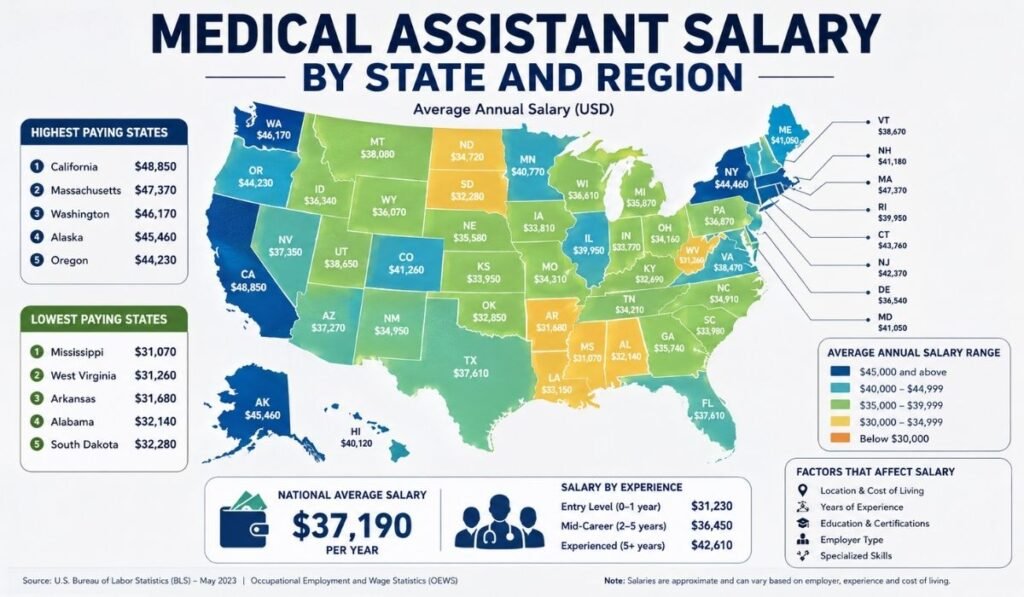
While seven of the nine fields are related to pay, at least in one way or another, that has more to do with location than actual practice, the cost of living, supply and demand for healthcare workers, and local wage standards. Higher living costs and strong healthcare demand in states such as California, Washington, Massachusetts, and Alaska usually produce regional pay well above the national average, sometimes stretching from $45,000 to over $50,000 a year. In other states with a lower cost of living, such as in parts of the South and Midwest, districts can be closer, but not above $30,000 to $35,000 per year.
Because metropolitan areas compete with urban hospital systems and specialty clinics for qualified personnel, these entities usually pay more than rural areas to fill the same position. Even the same job title in a small town within the same state can pay 15 to 25 percent lower than in something like New York City, with the assumption that salaries correlate highly with cost of living, even accounting for burden.
Read Also: Village Accountant Salary
Factors That Influence Medical Assistant Salary
Many variables combine to calculate where your pay stands in the wider range:
- Certification: Those with a CMA or RMA certification typically make $1,000 to $3,000 more a year than those who work without one.
- Specialty setting: Assistants in cardiology, dermatology, or surgical specialties commonly make more than those working in a general family practice.
- Type of employer: Larger hospital systems and multi-specialty groups generally pay higher than small independent practices, although the latter may be seen as offering more reasonable hours or benefits.
- Shift and schedule: working evening or weekend shifts, or being on call frequently, has pay above standard daytime rates.
- Bilingual skills: Command of a second language, in particular Spanish in many US areas, can also boost salary prospects in patient-facing positions.
- Years at the practice: Long-serving assistants typically receive regular raises, which can be much higher than what a newly hired person would negotiate in the same practice.
Medical Assistant Salary Compared to Related Roles
This is how this pay compares against other entry-level points into healthcare, which can be helpful. Phlebotomists and certified nursing assistants (CNAs) are usually more in the mid category, while nurse practitioners make less on average, licensed practical nurses (LPNs) and pharmacy technicians with an added certification typically make more. Medical assistants are at a mid-level: it takes more clinical training than being a receptionist or CNA, but the amount of formal education is lower than becoming licensed as a nurse, and generally, a medical assistant’s salary is commensurate with that position in the healthcare pay pyramid.
Sample Medical Assistant Salary Breakdown
The following table is a quick-reference summary of annual and hourly pay estimates across experience milestones.
| Experience Level | Annual Salary Range | Hourly Rate Range | Typical Profile |
| Entry-level (0-1 yrs) | $32,000 – $36,000 | $15 – $17 | New graduate, building speed |
| Early career (1-4 yrs) | $36,000 – $40,000 | $17 – $19 | Independent patient load |
| Mid-career (5-9 yrs) | $40,000 – $46,000 | $19 – $22 | Lead or training duties |
| Experienced (10+ yrs) | $45,000 – $52,000 | $21 – $24 | Specialty or supervisory role |
| Certified (CMA/RMA) | +$1,000 – $3,000 | +$0.50 – $1.50 | Any experience level |
| High cost-of-living state | $45,000 – $50,000+ | $22 – $26 | CA, WA, MA, AK metro areas |
How to Increase Your Medical Assistant Salary

With that said, the upward movement of this pay is typically due to a small number of intentional actions instead of just sitting and waiting for raises:
- Certification Earned: Getting a CMA or an RMA will be one of the quickest means to raise pay because many employers offer a direct wage premium for certified employees.
- Specialization: Transition to a specialty department like cardiology, orthopedics, or dermatology often yields higher pay than general practice positions.
- Embrace responsibilities: Assisting in training new hires or coordinating scheduling can help an assistant slide into a lead or office manager role, and these typically pay more.
- Evaluate local compensation before an interview: Learn the wage range in your area, so you can negotiate rather than accept the first offer made to you.
- Think about moving: Moving to a high-cost-of-living metro area with strong healthcare demand can dramatically elevate take-home pay in income, even after factoring in expenses.
- Continue your education: Many medical assistants use the position as a stepping stone into nursing or physician assistant programs that can greatly increase their lifetime earnings.
Medical Assistant Benefits Beyond Base Pay
Base pay is part of the total compensation equation. In fact, even when the hourly rate looks good on paper, many employers round out an offer with benefits that actually matter to the take-home value. Health insurance, paid time off, retirement matching, and continuing education reimbursement are the most common across hospital systems and large clinic networks, while many independent practices offer fewer formal benefits or compensate with more flexible scheduling or a quicker road to a raise.
The third piece that is worth considering is shift differentials. Assistants who take evening shifts, weekend shifts, or on-call shifts often see a small hourly bump over the daytime rate, and that can add up very quickly over a year of work without changing their base rate. Overtime classification is different: unlike many other healthcare professions, most medical assistants are considered nonexempt hourly employees, meaning that time-and-a-half kicks in once weekly hours hit the overtime limit (typically 40 per week in most places).
Read Also: Postal Assistant Salary
Job Outlook for Medical Assistants
As far as deciding whether or not the profession is a good career choice for you, in addition to pay numbers today long-term outlook too. Outpatient care, urgent care centers, and preventive medicine have been abundantly expanded in the last 10 years+, and a lot of this growth depends on support staff that can perform clinical as well as administrative duties seamlessly. It has sustained strong demand for trained assistants across most regions and thus backed continued, albeit slow growth in pay over time.
Not every year sees a huge pay increase, but greater demand means that qualified assistants (and especially certified ones with a few years of experience) seldom find themselves without job choices. Such stability is one reason why so many individuals treat the position as a long-term career or as an effective stepping stone in pursuit of additional healthcare-related education.
What to Expect During Salary Negotiations

Pay negotiations for this role are often less intimidating than candidates anticipate, especially for those with certification or specialist experience. A couple of practical approaches can allow the process to be much smoother:
- Do the homework: National averages aren’t your best bet on regional pay. You’re looking for pay stats at the city or metro level, where it’s usually more accurate for an actual offer.
- Certify the leads: By identifying a CMA or RMA credential early in the discussion, this indicates an upper hand when presenting your offer.
- Inquire about the whole package: Base salary is one thing, but shift differentials, benefits, and review timelines all play a role in determining the true acceptance value of an offer.
- The concept has been around for some time. Get the raise timelines in writing. One of the items that employees can learn about during their next performance review is when it takes place.
- Compare offers where possible: Even having one competing offer, formal or informal, almost always improves a candidate’s negotiating position.
Salary vs. Cost of Living
Just because the number is high on paper does not mean that more disposable income follows. While a $48,000 salary for an assistant in a high-cost metro area may not leave rent and daily expenses with as much spending power as his or her counterpart earning $36,000 in a smaller city with lower costs. When looking at job offers in various locations, compare the provided amount against home prices, transportation costs, and state or local taxes, not just the pure number. This is really important for candidates who are only thinking about moving to follow a better headline offer.
Common Missteps That Cost Money
Several unnecessary habits unnecessarily put a ceiling on the potential earnings you can have as an assistant. One of the most common is having a single employer for years while never having revisited pay; many practices only offer real raises when an employee pushes directly or brings competing offers to the table. Another reason is not completing certification because it feels optional, since oftentimes the time put into it up front gets paid back quickly with higher initial offers. Lastly, taking the first number in an interview without bothering to consult local pay data before arriving will help candidates who might have gotten more than they asked for.
Read Also: DevOps Engineer Salary
Frequently Asked Questions: Medical Assistant Salary
How much does a medical assistant make in the USA?
Nationally, the average annual salary for medical assistants working full time typically ranges from $38,000 to 42,000 per year (or around $18 to 20 per hour), depending on state and individual credentials.
Unlike some healthcare positions, certification actually does seem to impact a medical assistant salary.
Yes. In fact, Certified Medical Assistants and Registered Medical Assistants make $1,000 to $3,000 more per year on average than those working side by side with someone who is not certified; many employers consider certification a pay tier.
What are the highest salaries for medical assistants by state?
Delaware, California, Washington, and Massachusetts possess some of the highest medical assistant salary data due to strong demand but higher living costs, all seeing annual salaries above $45,000.
How does a medical assistant salary stack up to a CNA’s or LPN’s?
Normally, the medical assistant salary is higher than a CNA’s pay but lower than an LPN’s salary because medical assistants get more clinical training than CNAs and fewer surgical duties compared to licensed nurses.
Is there a way to increase a medical assistant salary without going back to school?
Yes. Significantly, this can be done through certification, focusing on a niche specialty area, advancing into lead responsibilities, and negotiating offers at the point of hire without the pressure of having to go back for another degree program.
Conclusion About Medical Assistant Salary
Medical Assistant Salary Range Based on Experience, Certification, and Location Medical assistant compensation ranges are determined by a variety of factors, including experience level, optional certification, geographic location, and practice specialty; however, in general, the trend amongst all medical assistants is a gradual, predictable increase for those who attain credentials and take on additional responsibilities. Where does your medical assistant salary fit in relation to state and national averages, whether

Prashant Kumar is the dedicated content writer and salary research author at TheMonthlySalary.com. He specializes in creating clear, helpful, and easy-to-understand content about monthly salary, in-hand pay, salary calculators, career growth, and salary updates. My goal is to simplify salary-related topics for employees, job seekers, students, and working professionals. Through well-researched guides and practical insights, Prashant helps readers make smarter career and financial decisions.