







Each year, thousands of aspirants look for the right details regarding the salary of an army clerk before they make a decision on taking an exam for Indian Army clerical jobs or not. Given that today’s offers for this post span traditional regular cadre recruitment and the relatively newer Agniveer scheme, it is important to understand how this pay structure works. Both paths get you good jobs inside unit offices, brigade headquarters and record offices but pay, perks, and future growth diverge widely. This guide covers the entire army clerk salary structure, in-hand salary, allowances, promotion levels, and answers the most frequently asked questions by aspirants.
What Is an Army Clerk
Army Clerk, actually enlisted under the trade name Clerk/Store Keeper Technical, is employed at unit and formation offices to perform clerical duties relating to personnel records, pay accounts, correspondence, stores documentation, and other routine paperwork. Unlike combat-oriented trades, the clerical branch is mostly stationed at unit headquarters and brigade offices, divisional HQ and command establishments, so it usually means limited field postings with regard to infantry.
Given the specialised, desk-based nature of the role, compensation includes a blend of fixed pay components and trade-linked allowances. Clerks should also be well-versed in typing at good speed, with knowledge of some basic computer applications, and since most of their official work involves writing letters, keeping service records, and coordination through different branches of a unit, they should have fair command over English and Hindi too.
Two Recruitment Routes: Regular Cadre vs Agniveer
After the announcement of the Agnipath Scheme, candidates can take part as a clerk in two ways. The first thing is normal Army Rally recruitment for Soldier Clerk / Store Keeper Technical, which is a full-time career, with pension and proper promotions. The second Path is Agniveer Clerk/Store Keeper Technical (Four-Year with Lump Sum exit package, no pension). Because the pay matrix and long-term advantages differ drastically by entry path, aspirants must be aware of both routes before applying.
Army Clerk Salary Structure: Quick Overview
The following table gives an overview of both major structures to compare the army clerk salary figures side-by-side before going into detail.
| Parameter | Regular Cadre | Agniveer Scheme |
| Entry Level Pay | Level 3 (Rs. 21,700 basic) | Rs. 30,000/month (Year 1 gross) |
| Approx. In-Hand (Year 1) | Rs. 28,000 – 38,000 | Rs. 21,000 |
| Tenure | Full career, up to 15+ years | Fixed 4 years |
| Pension | Yes, after qualifying service | No |
| Exit Benefit | Pension + gratuity | Seva Nidhi (~Rs. 11.71 lakh) |
| Permanent Absorption | Not applicable | ~25% selected after 4 years |
Regular Army Clerk Salary: Pay Matrix and Structure
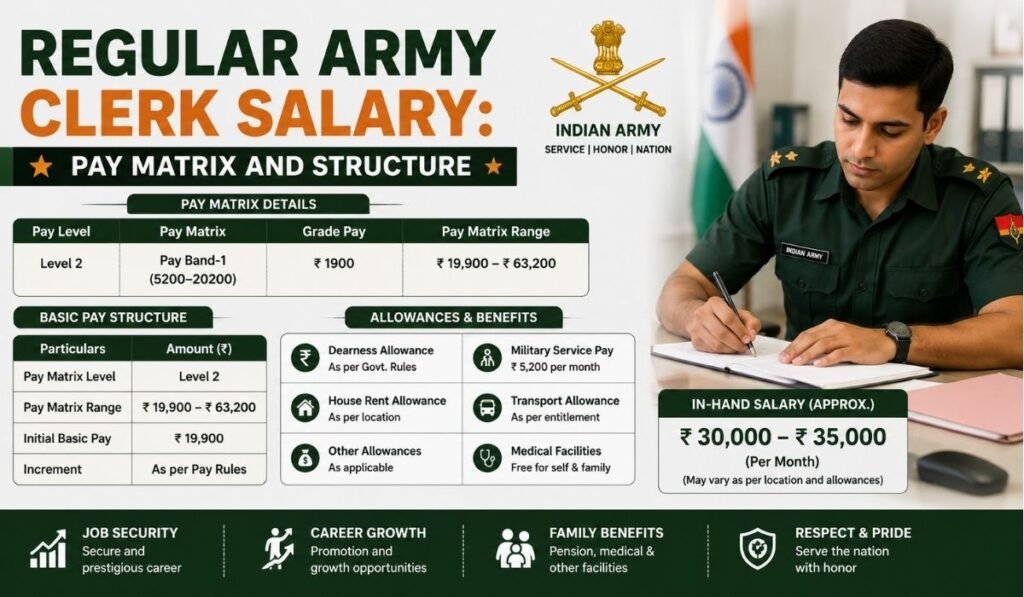
In the case of regular cadre, pay rates are governed by the Pay Matrix (as per 7th Central Pay Commission), starting at Level-3 equivalent to basic pay of Rs. 21,700 each month. Besides the basic salary, clerks are paid a Military Service Pay of Rs. 5,200 along with Dearness Allowance, House Rent Allowance and other allowances as applicable. In other words, the basic pay at entry level, even after including all allowances, usually comes to an in-hand amount of around Rs. 28-thousand, 38-thousand per month depending on place of posting (and HRA applicable).
Read Also: Forest Guard Salary
Regular Army Clerk Salary Pay Matrix
| Component | Amount (Approx.) |
| Basic Pay (Level 3) | Rs. 21,700 |
| Military Service Pay (MSP) | Rs. 5,200 |
| Dearness Allowance (DA) | As per current DA rate |
| House Rent Allowance (HRA) | As per posting city category |
| Approx. Gross In-Hand | Rs. 28,000 – 38,000 |
Agniveer Clerk Salary: Year-Wise Breakdown
Agnipath Candidates shall be recruited based on a fixed four-year salary structure (Rise is annual). The overall monthly package starts at Rs. 30,000 in Year 1 and increases to Rs. 40,000 by Year 4. Out of this monthly package, 70 per cent is credited directly to the hand salary while the rest is deposited into the Agniveer Corpus Fund, which is matched by the Government of India on a month-to-month basis. This structure implies that the take-home monthly remuneration for an Agniveer is lower than what is paid to a personnel of the regular cadre at a comparable salary level, but it creates a healthy corpus in amount.
Agniveer Clerk Salary Year-Wise Structure
| Year | Gross Monthly Package | Corpus Fund (30%) | In-Hand Salary (70%) |
| Year 1 | Rs. 30,000 | Rs. 9,000 | Rs. 21,000 |
| Year 2 | Rs. 33,000 | Rs. 9,900 | Rs. 23,100 |
| Year 3 | Rs. 36,500 | Rs. 10,950 | Rs. 25,580 |
| Year 4 | Rs. 40,000 | Rs. 12,000 | Rs. 28,000 |
In-Hand Salary vs Gross Salary: Understanding the Difference
While searching for this pay structure on the web, one of the common confusions is gross package v/s in hand pay. The gross monthly package is the total amount of your salary and includes the full amount before the compulsory Corpus Fund deduction of 30 percent, but in-hand salary is only what goes into your bank account each month for Agniveer clerks. The net amount is closer to the gross amount for regular cadre clerks since there are no equivalent corpus deductions, but other standard deductions like Army Group Insurance and canteen contributions still hold good. This difference is crucial for aspirants to compare army clerk salary across the two entry routes without comparing headline numbers.
Allowances and Benefits Included in Army Clerk Salary
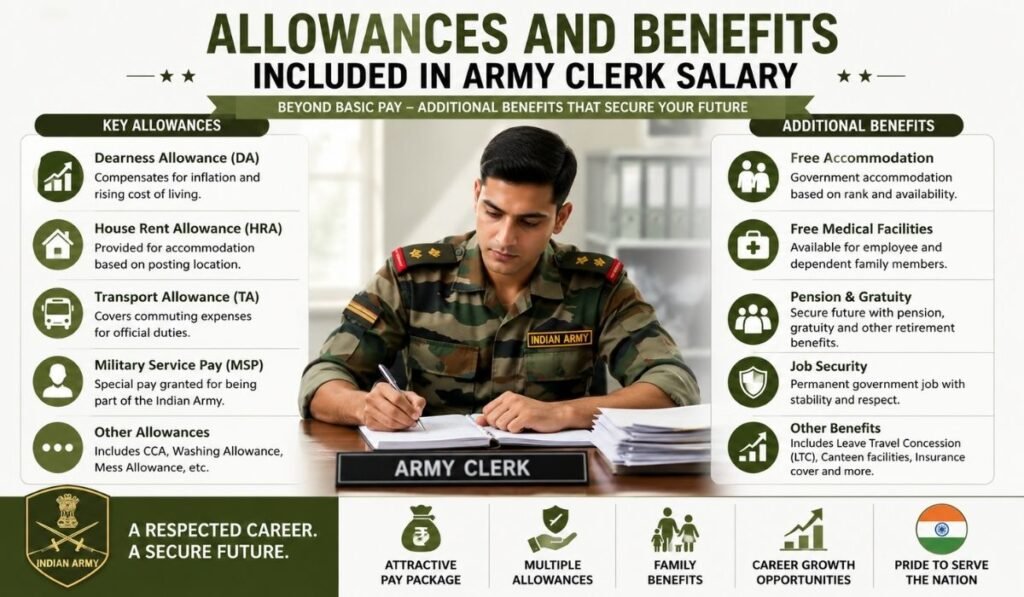
In addition to the basic pay, quite a few allowances are added according to posting, rank, and service conditions. Such allowances, which play an important role in understanding the total army clerk salary, can greatly enhance the final amount that you take home in hand.
Common Allowances Added to Army Clerk Salary
| Allowance | Applicability |
| Military Service Pay (MSP) | All regular cadre personnel |
| Dearness Allowance (DA) | Revised periodically with inflation |
| House Rent Allowance (HRA) | If government quarters not provided |
| Ration Allowance | All ranks, as per entitlement |
| Field/High Altitude Allowance | Applicable postings only |
| Risk and Hardship Allowance | Agniveers, as applicable |
Read Also: Medical Assistant Salary in 2026
Promotion and Career Growth for Army Clerks
Its biggest plus point over the regular cadre structure is the quicker promotion route ( in comparison to many other trades) since these clerical skills are required everywhere, whether it be unit offices or even formation HQs. The usual career path starts from Clerk, then goes on to Havildar Clerk level 5, next is Naib Subedar at Level 6, and finally one can rise to the position of Subedar Major in this category depending on the performance during that time frame. With every promotion, there is a significant increase in compensation along with additional record-keeping and office administration duties as well.
Army Clerk Salary by Rank and Experience
| Rank | Pay Matrix Level | Approx. Experience |
| Clerk | Level 3 | Entry level |
| Havildar Clerk | Level 5 | 8 – 10 years |
| Naib Subedar | Level 6 | 15+ years |
| Subedar / Subedar Major | Level 7 – 8 | 20+ years |
Eligibility Criteria for Army Clerk Recruitment
Both versions of this career path require candidates to meet specific education and physical health standards. At least 60 percent aggregate marks in the Class 12 or equivalent examination with a minimum of 50 percent marks in English and significant Mathematics or Accounts or Book Keeping is the minimum qualification. For the regular cadre, an upper age limit of 17.5 to 21 years exists for the role of Agniveer Clerk/Store Keeper Technical (this may vary depending on the specific recruitment notification).
Running, height, and chest measurements are conducted through the Army Rally or the recruitment rally held as per the Agnipath Scheme as physical fitness standards. The candidates also have to pass a thorough medical test based on eyesight, hearing, and common fitness (any disqualifying medical condition can threaten selection, whether or not the candidate is successful in the written exam).
Army Clerk Salary Compared to Other Army Trades
Aspirants generally would like to know how this pay stacks up against other trades like General Duty soldiers or Technical tradesmen. The gross monthly package for an Agniveer is largely common across all Agniveer trades under the Agnipath Scheme, and so a Clerk/Store Keeper Technical Agniveer receives broadly the same gross monthly package as a General Duty or Technical Agniveer in any year of service. However, much like Combat trades, salary can vary slightly for Regular cadre members as Group Pay and Technical Pay will sometimes apply depending on specialised roles in which you’d be selected to serve, though the core Pay Matrix Level and Military Service Pay stays constant among most soldier trades.
How to Apply for the Army Clerk Post

The recruitment for this post, whether regular cadre or Agniveer, starts with a notification which is released by the Indian Army through Army Recruiting Offices across India. The candidates have to fill an online application and can appear for the Common Entrance Examination, followed by a Recruitment Rally, which includes physical fitness tests, physical measurement, and document verification.
Candidates not only have to pass all stages but also a medical test after which they are inducted and trained before being posted to their units. Training is conducted over several months and combines basic military skills, such as drill and weapon handling, with trade-specific clerical training in office procedures, documentation, and record management. All recruits are expected to be ready for the rigors of soldiering as well as desk duties.
Read Also: Village Accountant Salary 2026
Seva Nidhi Package and Post-Service Benefits
It also provides a unique exit benefit, called the Seva Nidhi package, in addition to the pay structure for Agniveer clerks. Agniveer also gets a one-time amount of around Rs. 11.71 lakh after four years of service, which is part of their own monthly contribution, the matched government contribution, and interest earned to date. You are excluded from all income tax on this payout meant for continued education, or to start a business, or move to another job. Also, as per performance during their tenure of four years, about 25 percent of Agniveers may be selected for permanent induction into the regular cadre, after which the regular pay structure would apply from then (till pension benefits), he added.
Why Army Clerk Remains a Popular Career Choice
More than just numbers, however, and that is the beauty of this post: job security, being respected as a worker and a far more sustainable working environment compared to much private-sector work. Clerks are seldom deployed to fire zones, generally work 9-5 except during emergencies, and acquire significant administrative skills that translate easily to government or private-sector work after their service. This is one of the better government career opportunities that people can get straight after Class 12, with its steady increase in pay, allowances, medical facilities as well as a pension or Seva Nidhi benefits.
Frequently Asked Questions
Q1. What is the starting army clerk salary under the Agnipath Scheme?
This starting figure under the Agnipath Scheme is Rs. 30,000 per month as a gross package, with an in-hand amount of around Rs. 21,000 after the mandatory Corpus Fund deduction.
Q2. What is the pay structure under the regular cadre?
Under the regular cadre, pay begins at Pay Matrix Level 3, with a basic pay of Rs. 21,700 plus Military Service Pay of Rs. 5,200, taking the in-hand figure to roughly Rs. 28,000 to 38,000 per month with allowances.
Q3. Does the compensation structure include a pension?
Regular cadre clerks are eligible for pension benefits after completing the required years of service, while Agniveer clerks do not receive a pension and instead get the one-time Seva Nidhi package after four years.
Q4. How much is the Seva Nidhi package for Agniveer clerks?
The Seva Nidhi package for Agniveer clerks is approximately Rs. 11.71 lakh, paid as a tax-free lump sum after completing the four-year service tenure.
Q5. What qualifications are needed to apply for this post?
Candidates need a Class 12 pass with at least 60 percent aggregate marks and a minimum of 50 percent in English and Mathematics or Accounts or Book Keeping.
Q6. How does the army clerk salary grow with promotions?
Pay increases significantly with each promotion, moving from Clerk to Havildar Clerk, and further to Naib Subedar and beyond, with each rank carrying a higher Pay Matrix Level.
Q7. Is pay the same across all Agniveer trades?
Yes, under the Agnipath Scheme, the gross monthly package is largely uniform across Agniveer trades, so the army clerk salary matches other Agniveer roles in the same year of service.
Q8. What allowances are added to the total pay package?
Common allowances include Dearness Allowance, House Rent Allowance, Military Service Pay, Ration Allowance, and additional compensation for postings in field or high-altitude areas.
Q9. Can Agniveer clerks become permanent Army employees?
Yes, around 25 percent of Agniveers may be selected for permanent induction based on performance, after which the regular army clerk salary and pension structure would apply.
Q10. Is this monthly pay taxable?
The monthly army clerk salary is taxable as per normal income tax provisions, though the final Seva Nidhi payout for Agniveers is completely exempt from income tax.
Read Also: Postal Assistant Salary
Conclusion
Regardless of whether you choose the regular cadre or opt for the Agniveer route, knowing about the full-fledged army clerk salary structure lets you decide on your profession wisely. Regular cadre provides for sustainable long-term growth, regular pension benefits, and a sTable income linked to the Pay Matrix, while Entry through Agniveer is quicker with a big Seva Nidhi payout at the end of four years. Regardless of the route chosen by defence aspirants, both lead to an eminent army job in the Indian Army administration middle ranks, and preparing well ahead with knowledge of accurate figures, pay, allowances, and promotion structure would help them attend the recruitment process confidently

Yashika is the dedicated content writer and salary research author at TheMonthlySalary.com. She specializes in creating clear, helpful, and easy-to-understand content about monthly salary, in-hand pay, salary calculators, career growth, and salary updates. Her goal is to simplify salary-related topics for employees, job seekers, students, and working professionals. Through well-researched guides and practical insights, Yashika helps readers make smarter career and financial decisions.