




For small businesses, reliable IT now means more than fixing a computer when it fails. Cloud accounts, employee devices, security policies, backups, and customer-facing applications all need ongoing attention, often without a large internal technology department. Managed IT services bring those responsibilities into a recurring support arrangement, but the scope varies significantly between providers. Some concentrate on everyday user and network support, while others manage custom software, cloud infrastructure, or specialized operational systems.
1. Itexus
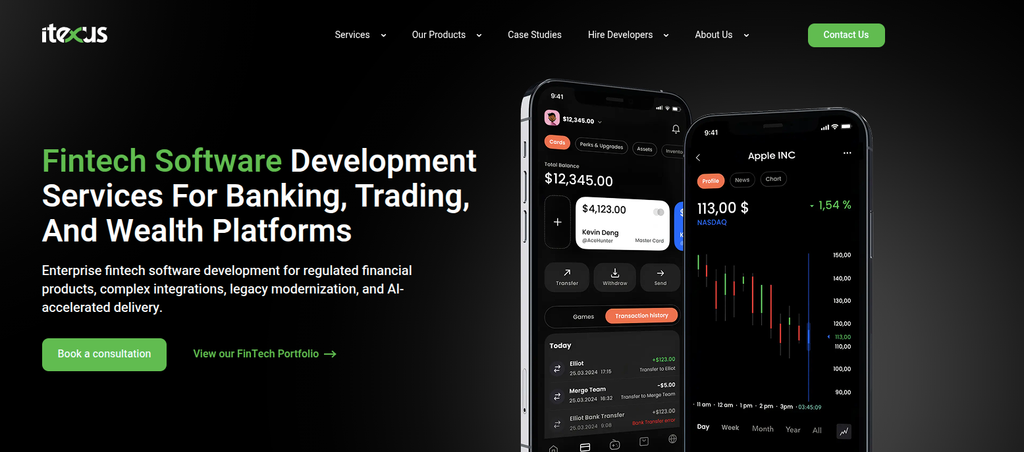
Itexus provides ongoing technical management for companies whose operations depend on custom software and cloud infrastructure. Its software support and maintenance work includes L2 and L3 assistance, production monitoring, incident escalation, patch and release management, performance tuning, and backup or rollback planning. DevOps engineers also work with cloud environments, deployment pipelines, observability, and infrastructure automation.
That combination is relevant to small financial technology firms and other software-driven businesses that need technical ownership beyond ordinary employee support. Itexus builds banking, payment, and investment platforms and can continue supporting the software after launch. Its engineering teams can investigate problems within application code, integrations, and deployment configurations rather than leaving those issues outside a standard help desk.
Key Facts
- Best for: Small businesses operating custom or financial software
- Core services: Managed IT, L2/L3 support, application maintenance, DevOps, cloud engineering
- Specialization: Production software, integrations, incident response
- Delivery focus: Ongoing operation and improvement of live applications
Contact Information
- Website: itexus.com
- Email: info@itexus.com
- Address: 8, The Green, STE road, Dover, DE 19901
- Facebook: www.facebook.com/itexus
- Instagram: www.instagram.com/itexus.soft
- LinkedIn: www.linkedin.com/company/itexus-fintech-software
- Twitter: x.com/ItexusSoft
2. OSKI Solutions
OSKI Solutions runs business applications, cloud environments, databases, and integrations through an engineering-led managed services model. The work includes monitoring and alerting, incident response, patching, dependency upgrades, backups, and recurring maintenance. Its teams manage AWS and Azure systems and can work directly in application code when a production incident requires more than a configuration change.
An engagement begins with reviewing the environment and clarifying operating responsibilities, escalation paths, and service levels. OSKI also takes over inherited software, which suits smaller organizations that have an important legacy application but limited internal engineering capacity. Regular service reviews and a planned improvement backlog tie operational support to system reliability and future changes.
Key Facts
- Best for: Small businesses relying on custom applications and cloud systems
- Core services: Managed applications, cloud operations, databases, integrations
- Cloud platforms: AWS and Microsoft Azure
- Operating model: Defined service levels and ongoing engineering maintenance
Contact Information
- Website: oski.site
- Email: contact@oski.site
- LinkedIn: www.linkedin.com/company/oski-solutions
3. A-listware
A-listware provides managed IT across devices, networks, servers, business applications, cloud infrastructure, and security. Its services include infrastructure assessments, continuous monitoring, server and cloud administration, operating system updates, vulnerability reviews, and Level 1 through Level 3 technical assistance. The company also supports application management and DevOps tasks alongside conventional infrastructure administration.
Small businesses can use A-listware for a fully managed service arrangement or to extend an existing internal team. Its ability to work across both infrastructure and software matters when an operational issue involves several technical layers, such as a cloud resource, application release, or database connection. Service scopes and performance expectations can be defined through service-level agreements.
Key Facts
- Best for: Businesses with mixed infrastructure and software support needs
- Core services: Managed IT, help desk, cloud, applications, security
- Support levels: L1, L2, and L3
- Service models: Fully managed and co-managed arrangements
Contact Information
- Website: a-listware.com
- Email: info@a-listware.com
- Phone: +44 (0)142 439 01 40
- Address: St. Leonards-On-Sea, TN37 7TA, UK
- Facebook: www.facebook.com/alistware
- LinkedIn: www.linkedin.com/company/a-listware
4. net-devs
net-devs delivers software and cloud platform engineering with an emphasis on production systems. Its capabilities include enterprise development, cloud-native architecture, infrastructure as code, and platform work on Azure, AWS, and Google Cloud. The company uses technologies such as Terraform and Kubernetes alongside backend stacks including .NET, Java, Node.js, Python, and Go.
For a small business with a custom product or internal platform, this engineering capacity is useful for maintaining deployment processes, improving infrastructure, and evolving systems already in use. Teams can address application and cloud architecture problems together, limiting handoffs between developers and infrastructure specialists. The practical fit is operational support tied to software and cloud platforms.
Key Facts
- Best for: Software-dependent small businesses needing cloud engineering
- Core services: Cloud platforms, application engineering, modernization
- Cloud platforms: AWS, Microsoft Azure, Google Cloud
- Technologies: Terraform, Kubernetes, .NET, Node.js, Python
Contact Information
- Website: net-devs.com
- Email: contact@net-devs.com
- Phone: +48 571 282 759
- Address: Obrzeżna 1D, 02-691 Warsaw, Poland
- LinkedIn: www.linkedin.com/company/net-devs
5. SoftPro
SoftPro builds and maintains custom web and cloud software using Microsoft technologies and modern frontend frameworks. Its work spans .NET and ASP.NET development, React applications, legacy modernization, cloud migration, and infrastructure management on Microsoft Azure and AWS. Continuous support and maintenance are available for the software it develops.
For smaller organizations, SoftPro fits situations where ongoing technology management revolves around a specific business application, portal, or cloud-hosted workflow. Developers can address functional defects and implement technical changes while supporting the system over time. That continuity is useful when keeping an application reliable requires access to the codebase and an understanding of its business processes.
Key Facts
- Best for: SMEs maintaining custom Microsoft-based applications
- Core services: Web development, cloud systems, modernization, maintenance
- Technologies: .NET, ASP.NET, React, Azure
- Location: Warsaw, Poland
Contact Information
- Website: soft-pro.pl
- Address: Poland, Warsaw Mazowieckie Voivodeship, 13 Erasmus Ciołka St. 401
6. 21Century.Tech
21Century.Tech develops and updates production software with senior engineers overseeing architecture, security decisions, code review, and quality. Its services cover full-stack features, legacy refactoring, third-party integrations, test coverage, documentation, CI/CD, and deployment. AI-assisted development tools support implementation, while engineers remain accountable for the technical outcome.
This approach is relevant to small businesses with software that must keep changing after its first release. An existing internal tool or customer-facing application may need integrations, release improvements, or a difficult refactor. 21Century.Tech provides code-level engineering for those operational needs, particularly where continuity and maintainability depend on changes to the application itself.
Key Facts
- Best for: Small teams maintaining and extending production software
- Core services: Full-stack development, refactoring, integrations, deployment
- Engineering approach: Senior oversight with AI-assisted implementation
- Operational focus: Tests, CI/CD, documentation, application changes
Contact Information
- Website: 21century.tech
- Email: contact@21century.tech
Conclusion
A managed IT agreement is most useful when responsibilities are explicit. Small businesses should check who owns endpoint security, account administration, backups, cloud monitoring, application support, and recovery procedures, because these tasks are not included in every service plan. Response coverage and escalation paths should match the hours when critical systems actually operate. A company with ordinary office technology may need a different support model from one running a custom revenue-generating platform. Clear reporting and a realistic improvement plan help keep recurring support connected to business continuity instead of becoming a collection of disconnected tickets.