





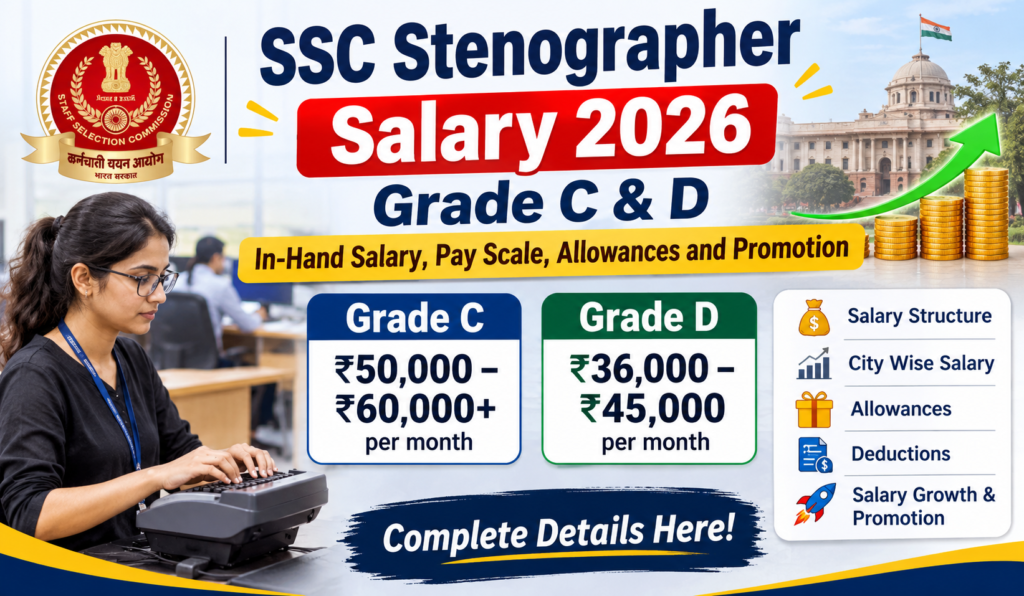
The SSC Stenographer Salary is one of the most important factors that lead candidates to appear for the Staff Selection Commission (SSC) Stenographer exam to get a government job. Through this recruitment process, candidates can secure employment with different Central Government departments/ministries/offices. Along with a fixed salary, employees also receive other benefits such as allowances, job stability, and opportunities for professional development.
The SSC (Staff Selection Commission) has two primary job roles: Stenographer Grade C and Stenographer Grade D. Although they are both stenographers, each position differs in terms of pay scale, job duties and career advancement possibilities. The actual salary you receive is determined by several factors, including your assigned grade, the government agency or department where you will work, the specific pay level of that position, your physical working location, and any additional Central Government benefits that may apply to you.
Grade D (typically) begins at Pay Level 4 and has a starting basic salary of ₹25,500, while Grade C appointments are normally made at either Pay Level 6 or Pay Level 7, depending on the specific department and vacancies available.
In this article, you will learn about the SSC Stenographer Salary for the year 2026. This includes grade wise salary, city wise differences in salaries, what is paid to you as in hand salary, different types of allowances given to employees, deductions that are made from your salary, how many promotions can be earned by a stenographer and finally, how fast can a stenographer earn more money throughout their career.
What is SSC Stenographer Salary?
SSC Stenographer Salary is the money paid each month to the candidates selected as Stenographers Grade C and D through the Staff Selection Commission (SSC) Exam.
Employees’ salaries are based upon the seventh Central Pay Commission (CPC) salary scale. Employees will be provided with several allowances in addition to their regular salary. These include Dearness Allowance (DA), House Rent Allowance (HRA) and Transport Allowance (TA), which will vary based upon employee’s eligibility and where they work.
The total monthly salary is generally divided into three parts:
- Basic Pay: The fixed starting salary according to the applicable pay level.
- Allowances: Additional payments such as DA, HRA and Transport Allowance.
- Deductions: Contributions towards NPS, CGHS and other applicable deductions.
Understanding that gross salary and “in-hand” salary are two distinct types of salaries is crucial. Gross salary refers to the sum of an employee’s basic pay plus any other applicable allowances, while “in-hand” salary represents the total salary an employee will receive after all deductions have been made.
SSC Stenographer Salary Overview
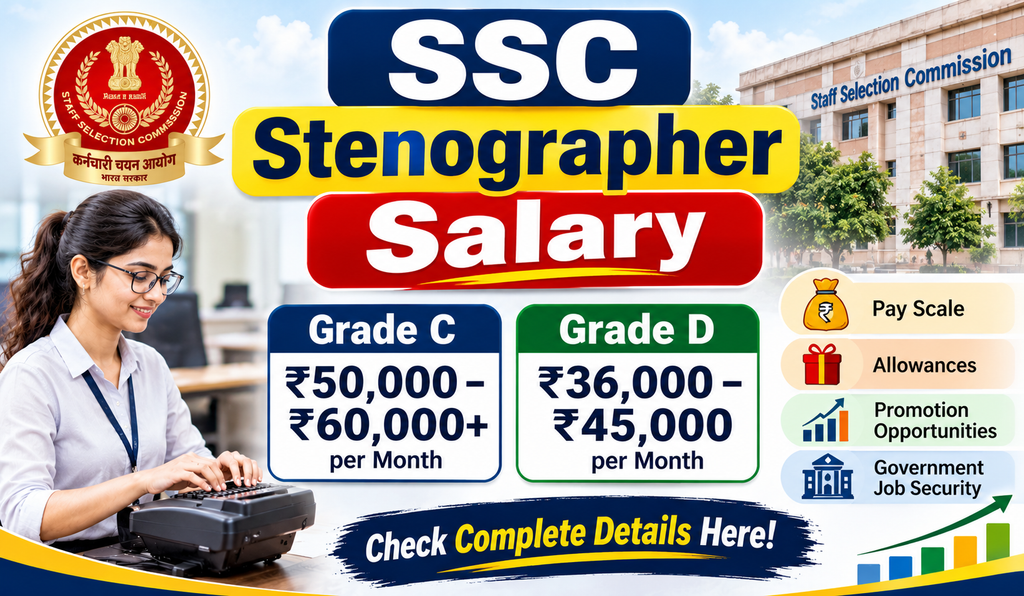
The SSC Stenographer salary structure differs between Grade C and Grade D. Grade C generally offers a higher pay level, while Grade D provides a comparatively lower starting basic salary.
Here is a quick overview of both positions under the 7th Pay Commission.
| Salary Details | Grade C | Grade D |
| Pay Level | Level 6 / Level 7 | Level 4 |
| Starting Basic Pay | ₹35,400 / ₹44,900 | ₹25,500 |
| Pay Scale | ₹35,400–₹1,12,400 / ₹44,900–₹1,42,400 | ₹25,500–₹81,100 |
| Group | Group B (Non-Gazetted) | Group C |
| Approx. Monthly In-Hand Salary | ₹50,000–₹60,000+ | ₹36,000–₹45,000 |
Note: These are indicative salary ranges, not guaranteed fixed amounts. The actual salary depends on the pay level, city classification, allowances, deductions and department.
SSC Stenographer Salary: Grade C
SSC Stenographer Grade C is a higher-level position compared with Grade D. Candidates selected for this post are generally appointed in Central Government ministries, departments and other government offices.
Grade C positions may carry Pay Level 6 or Pay Level 7, depending on the department and specific vacancy. Therefore, not every Grade C employee receives the same starting basic salary.
Grade C salary details
| Particulars | Pay Level 6 | Pay Level 7 |
| Starting Basic Pay | ₹35,400 | ₹44,900 |
| Maximum Basic Pay | ₹1,12,400 | ₹1,42,400 |
| Grade | C | C |
| Group | B (Non-Gazetted) | B (Non-Gazetted) |
| Approx. Gross Salary | ₹63,000–₹74,000 | ₹79,000–₹93,000 |
The salary increases through annual increments, DA revisions and promotions. Employees may also receive additional benefits according to their department’s rules.
SSC Stenographer Salary: Grade D
SSC Stenographer Grade D is usually considered to be a Group C government job. Those who get hired for the Stenographer Grade D position will work in different Central Government organizations and departments.
The position provides an initial base pay of Rs. 25,500 per month, as determined by the Seventh Pay Commission’s Pay Level 4.
Grade D salary details
| Particulars | Salary |
| Pay Level | Level 4 |
| Starting Basic Pay | ₹25,500 |
| Maximum Basic Pay | ₹81,100 |
| Pay Scale | ₹25,500–₹81,100 |
| Group | Group C |
| Approx. Gross Salary | ₹46,000–₹55,000 |
Employees in Grade D will receive, along with their basic pay, an allowance for Dearness Allowance (DA), House Rent Allowance (HRA) and Transport Allowance. The total amount earned by these employees each month is determined by the location of where they work and any applicable deductions.
SSC Stenographer Salary City Wise
The city where the employee is posted has a big impact on what the employee gets paid each month. Generally, employees who work in large metropolitan areas will have a larger amount of money added to their paycheck as part of their housing allowance (HRA) compared to employees who are located in smaller cities.
Under the 7th Pay Commission, cities are classified into three categories: X, Y and Z.
| City Category | HRA Rate | Examples |
| X Class | 30% | Delhi, Mumbai, Kolkata, Chennai, Bengaluru, Hyderabad, Pune and Ahmedabad |
| Y Class | 20% | Lucknow, Jaipur, Chandigarh, Patna and other eligible cities |
| Z Class | 10% | Other eligible towns and locations |
The HRA rates shown above are based on the DA reaching 50% as prescribed. HRA is calculated as a percentage of Basic Pay, not of Basic Pay plus DA.
Department of Expenditure+1
How does the city affect salary?
- X-category cities generally offer the highest HRA.
- Y-category cities provide a moderate HRA benefit.
- Z-category locations have comparatively lower HRA.
- Transport Allowance can also differ according to the notified city and applicable pay-level rules.
For example, an employee with a basic salary of ₹25,500 receives ₹7,650 as HRA in an X-class city, ₹5,100 in a Y-class city and ₹2,550 in a Z-class city.
SSC Stenographer Salary Per-month Structure 2026
The SSC Stenographer salary structure includes both the base pay and several types of allowances. All applicable allowance rates are determined by the Department of Expenditure for each type of Central Government employee.
The dearness allowance (DA) will be increased effective July 1, 2026. At that time, DA will go from 60% of an employee’s basic pay to 63% of an employee’s basic pay. The increase in DA will affect the total amount of money earned by each eligible employee.
The main salary components are:
| Salary Component | Details |
| Basic Pay | Fixed pay according to the pay matrix |
| Dearness Allowance | 63% of basic pay as of July 2026 |
| House Rent Allowance | 10%, 20% or 30% according to city classification |
| Transport Allowance | Depends on pay level and eligible posting city |
| Other Benefits | Medical, leave and retirement-related benefits as applicable |
Example of monthly salary calculation
For a Grade D employee receiving a starting basic salary of ₹25,500:
| Component | Amount |
| Basic Pay | ₹25,500 |
| DA (63%) | ₹16,065 |
| HRA (X City – 30%) | ₹7,650 |
| Transport Allowance (including DA) | ₹5,868 |
| Approx. Gross Salary | ₹55,083 |
This is an illustrative calculation for an eligible higher-Transport-Allowance city. Actual payroll may differ according to posting, eligibility and department-specific rules.
SSC Stenographer In-Hand Salary 2026
An employee’s in-hand salary for the position of SSC Stenographer will be what remains in their bank account after any necessary deductions have been made.
An employee’s total compensation includes his/her base salary plus all applicable benefits. However, employees are required to make contributions to their respective retirement programs as well as other state/federal mandated contributions.
As a result of the 63 percent DA rate becoming effective in July of 2026, the following values illustrate estimated starting monthly take-home salary.
| Grade | Pay Level | X City | Y City | Z City |
| Grade C | Level 7 | ₹84,500 | ₹80,000–₹82,000 | ₹74,000–₹77,000 |
| Grade C | Level 6 | ₹67,500–₹68,000 | ₹61,000–₹64,000 | ₹58,000–₹60,000 |
| Grade D | Level 4 | ₹50,000–₹51,000 | ₹44,000–₹48,000 | ₹42,000–₹43,000 |
The estimates provided represent NPS, estimated CGHS and insurance contributions, as well as several different types of transportation allowances. Estimates were made prior to the application of each employee’s individual income taxes and other personal deduction amounts. The estimates of salaries for cities do not represent fixed salary guarantees.
For candidates, the main difference between Grade C salaries is whether the position will carry Level 7 or Level 6.
SSC Stenographer Salary Allowances
In addition to their regular pay, SSC Stenographers are eligible for various types of allowances and job-related benefits that increase the financial appeal of the job to individuals who wish to work as a public servant for an extended period of time.
The major allowances are explained below.
Dearness Allowance (DA)
Central Government Employees are entitled to Dearness Allowance as an adjustment for how inflation affects their cost of living.
The current DA rate is 63% of your basic pay as of 1 July 2026. Typically, the Government of India reviews the DA rate every six months, which means there could be adjustments to the DA rate in the future.
House Rent Allowance (HRA)
Employee benefits include Housing Allowance (HRA) which is given to employees as an aid to cover housing costs. The amount of HRA that an employee receives is dependent upon the category of the city in which the employee’s job location is situated.
- X-class cities: 30% of basic pay.
- Y-class cities: 20% of basic pay.
- Z-class cities: 10% of basic pay.
Employees occupying government-provided accommodation may not receive HRA as usual, subject to the applicable rules.
3. Transport Allowance (TA)
Transport Allowance helps employees cover their daily commuting expenses.
The amount of the TA will depend upon the employee’s salary grade, and if the posting location has a high TA qualification. Additionally, DA is based on the allowed TA.
4. Medical Benefits
Employees who qualify can obtain healthcare services from either the Central Government Health Service (CGHS) or a relevant department-based health care program.
The employer’s benefits can extend to both the employee and their qualified dependents based on government regulations.
5. Leave Travel Concession (LTC)
Under the applicable Central Government rules, eligible employees can obtain the benefits of Leave Travel Concession for traveling within India.
6. Retirement Benefits
Employees who are hired in accordance with the National Pension System (NPS) regulations will receive their retirement benefits. In addition, some eligible employees may be able to opt for the Unified Pension Scheme, provided they meet the relevant government guidelines and eligibility criteria.
Other advantages may include paid time off from work, maternity/paternity leave (if available), and group insurance coverage.
Major Deductions in Stenographer Salary
Although the SSC Stenographer salary includes several allowances, certain deductions are made before the final monthly salary is credited.
Here are the major deductions that employees may notice on their salary slips.
| Deduction | Purpose |
| NPS Contribution | Employee’s pension contribution, generally 10% of basic pay plus DA |
| CGHS Contribution | Medical scheme subscription, where applicable |
| CGEGIS | Central Government Employees Group Insurance Scheme |
| Income Tax | Deducted according to applicable income-tax rules |
| Professional Tax | Applicable in states where it is levied |
| Other Recoveries | Any authorised departmental or personal recoveries |
The NPS employee contribution is usually ten percent of the employee’s basic salary, which includes the Cost of Living Allowance (DA), for all employees covered under the NPS. The employer’s contribution to the NPS is separate and should not be considered an extra amount of money that will be deposited into the employee’s monthly bank account.
The final amount that is deducted from each employee’s pay may be different depending upon which type of pension arrangement they belong to, whether or not they are covered by a medical scheme, their individual tax obligations, and any other relevant factors.
SSC Stenographer Salary Growth or Promotion
The SSC Stenographer provides individuals with opportunities to advance their careers in various government departments. Through departmental promotions, length of service (seniority), written exams, and other criteria established by the department, employees may be promoted to higher positions.
A Grade D Stenographer may be eligible to move up to Grade C by taking the next level exam through the relevant departmental promotion or Limited Departmental Competitive Examination (LDCE).
The SSC holds examinations for promotions of stenographers to the next higher level of their profession, which is Grade C, within some organizations. These organizations include the Central Secretariat Stenographers Service.
A general career progression may include:
- Stenographer Grade D
- Stenographer Grade C
- Private Secretary
- Senior Private Secretary
- Principal Private Secretary
However, the above represents a typical progression of roles in the Civil Service and does not represent a mandatory promotion structure for all SSC stenographer employees. Promotional titles, requirements, openings, and salary scales are dependent upon the specific organization or agency.
SSC Stenographer Salary After 5 Years
The salary of an SSC Stenographer generally increases with experience. Employees receive annual increments, and their DA may also increase through government revisions.
The following table provides an indicative salary-growth picture for different stages of service.
| Experience | Approximate Monthly Salary |
| New Joining Person | ₹36,000–₹60,000 |
| After 3 Years | ₹45,000–₹75,000 |
| After 5 Years | ₹55,000–₹90,000 |
| After 10 Years | ₹70,000–₹1,00,000 |
These are indicative average salaries for each grade/pay level; they do not represent actual take home pay. The amount of increase will vary based upon the initial pay rate, annual increases, DA changes, HRA, promotions and where you work.
What happens after five years?
An employee who stays in the same grade will receive their yearly increment based upon the pay scale. As an example, the starting salary of a person at Level 4 would be ₹25,500 and after receiving 5 yearly increments (assuming there was no disruption to their normal advancement through the cells within the pay matrix), that person’s new starting salary would be ₹29,600.
In the same manner, the starting wage for an employee at Level 6 increases from ₹35,400 to ₹41,100 through five yearly increases.
During this time frame, if you are promoted, your wage will increase and so will your potential for future wage increases.
SSC Stenographer Salary After 7th Pay Commission
The 7th Pay Commission has created a new pay structure (matrix) for all Central Government employees. The salaries for SSC Stenographer Grade C and Grade D will be based upon the same pay structure.
The starting basic pay under the 7th Pay Commission is:
| Stenographer Post | Pay Level | Starting Basic Pay | Pay Scale |
| Grade C | Level 6 | ₹35,400 | ₹35,400–₹1,12,400 |
| Grade C | Level 7 | ₹44,900 | ₹44,900–₹1,42,400 |
| Grade D | Level 4 | ₹25,500 | ₹25,500–₹81,100 |
The salary also increases with annual increments and periodic allowance revisions.
Important Note: The approximate monthly salaries of ₹50,000 to ₹60,000 for Grade C positions and ₹36,000 to ₹45,000 for Grade D positions are sometimes cited in older estimates of what people would earn. However, you should not assume that these estimates represent the most recent or current level of compensation. After DA has increased to 63% on July 2026, the initial earning potential could be greater than estimated, especially if you were hired into Grade C Level 7 positions located in X-Class cities.
The 8th Pay Commission should also be reviewed independently. Salary revisions in the future will depend upon what the Government accepts as recommended by the 8th Pay Commission, and when they implement the changes. The calculations presented in this article were calculated using the 7th Pay Commission.
Important Official Links Regarding SSC
Candidates preparing for the SSC Stenographer examination should regularly check the official SSC website for recruitment notifications, examination dates, results, answer keys and other important updates.
Here are some useful official resources:
| Official Resource | Purpose |
| SSC Official Website | Recruitment notifications and latest updates |
| SSC Candidate Section | Candidate-related information |
| SSC Examination Notices | Examination notifications and announcements |
| Department of Expenditure | DA, HRA and allowance-related government orders |
| Department of Expenditure Official Website | Central Government pay and allowance information |
Candidates should rely on official notifications and departmental orders instead of unofficial salary charts when checking the applicable pay level.
What is the SSC Stenographer Job Profile?
An SSC Stenographer will provide clerical and administrative support for government employees and organizations. The primary responsibilities of this position include dictating in shorthand, transcribing dictated material, creating documents and communicating.
Each day’s job tasks can vary based upon what department a stenographer is employed in, and who they report to.
Some major responsibilities include:
- Taking dictation is the act of recording speeches, formal instructions, meeting proceedings, and letters using shorthand.
- Transcription: The process of taking short hand notes and creating them as properly formatted documents with the use of a computer.
- Creating Official Paperwork: Writing letters, reports, notices and all other types of administrative paperwork.
- Maintaining Records: Organising official files, documents and correspondence.
- Secretarial Assistance to Senior Officials: Supporting senior level officials within the government with secretarial duties.
- Managing Communication: Communication management, which includes processing of official communication and interaction among various departments.
- Assistance for Meetings: Recording relevant discussions and producing meeting documentation.
The position will require a good rate of taking dictation (shorthand), ability to use a keyboard to enter data (typing skills), ability to produce work with little error (accuracy), ability to manage one’s own schedule and meet deadlines (time management), and ability to communicate effectively with clients/coworkers (professional communication).
What Major Reasons for SSC Stenographer Salary Attracts Candidates?
SSC Stenographer is a well-known recruitment test for the public sector, as it provides both financial security, professional growth potential and public sector job advantages.
The following factors make the position attractive to candidates.
- The central government’s pay matrix determines how much an employee earns each month.
- The job provides the security of working for the government on a regular basis, which is subject to the rules and regulations of the service.
- Total Monthly Earnings Include Additional Allowances: DA, HRA, and Transport Allowance increase your overall monthly income.
- Promotion Opportunities: Employees may be promoted to positions of higher responsibility based on the departmental promotional policies.
- Eligible employees are entitled to retirement-related benefits as defined by their respective pension plan.
- Government medical benefits are available based on the applicant’s eligibility and departmental regulations.
- Work-life balance is a common benefit found in many of these job openings. These job descriptions often state that there will be a set schedule for your work day. However, depending upon which area of the company you are working in and what your job duties entail, the amount of time you spend at work can vary.
- Professional Experience: Employees get work experience with Government Officers, Ministries and Administrative Departments.
After passing 12th standard, if a candidate is looking for a steady job in government sector then SSC stenographer is a good option.
Conclusion
The SSC Stenographer Salary 2026 offers an attractive combination of basic pay, government allowances, retirement benefits and career growth opportunities. Grade D employees will typically be paid in the first level (level 4) of the pay scale with a starting basic salary of ₹25,500. Depending upon which department they are employed in and their pay scale, Grade C employees can potentially have a starting basic salary of either ₹35,400 or ₹44,900.
Actual in-hand salary varies based on the location of the employee’s post, DA (Dearness Allowance), HRA (House Rent Allowance), Transport Allowance and any applicable deductions. Salary increases can be expected through annual raises and promotions.
Candidates should refer to the most recent SSC vacancy list and official government pay orders in order to find out the salary amount associated with their chosen position.
Frequently Asked Questions (FAQs)
1. What is the SSC Stenographer salary in 2026?
The starting pay scale for a Grade D stenographer is ₹25,500. For Grade C, the starting pay is either ₹35,400 or ₹44,900 based upon the relevant pay level. In addition to these amounts, the employee’s monthly in-hand salary will vary depending on their location and additional benefits.
2. What is the in-hand salary of SSC Stenographer Grade C?
The SSC Stenographer Grade C can earn an estimated salary of ₹60,000 to ₹85,000 (or higher) each month based on their appointment being at Level 6 or Level 7 and where they are located for work.
3. What is the in-hand salary of SSC Stenographer Grade D?
Grade D employees can receive approximately ₹42,000–₹51,000 per month at the starting pay stage, depending on their city, allowances and deductions.
4. Is SSC Stenographer a Group B or Group C job?
Stenographer Grade C is generally a Group B non-gazetted post, whereas Stenographer Grade D is a Group C post.
5. What is the basic pay of SSC Stenographer Grade D?
The starting basic pay of SSC Stenographer Grade D is ₹25,500 under Pay Level 4 of the 7th Pay Commission.
6. What is the basic pay of SSC Stenographer Grade C?
Grade C appointments can have a starting basic pay of ₹35,400 under Level 6 or ₹44,900 under Level 7, depending on the department.
7. Does SSC Stenographer receive HRA and DA?
Yes, eligible employees will be paid Dearness Allowance and House Rent Allowance in accordance with the relevant Central Government regulations. The amount of HRA depends upon how the city where the employee is posted is classified.
8. Can an SSC Stenographer Grade D get promoted to Grade C?
Yes, a Grade D employee can potentially promote to Grade C via department-specific promotions processes or through any applicable Limited Departmental Competitive Examination that is available. These opportunities are subject to established service rules and vacant positions.
9. What is the SSC Stenographer salary after 5 years?
Normally, the SSC stenographer salary goes up due to both the yearly increments and changes in the Dearness Allowance (DA). If a Grade D employee receives all five yearly increments without interruption, his/her basic salary could rise from ₹25,500 to ₹29,600.
10. What is the SSC Stenographer job profile?
The SSC Stenographer does the following tasks: takes down shorthand dictation; types up the dictated notes; prepares all of the official letters and documents; maintains records; and provides administrative support to senior officials within the government.
You May Also Check For:

Prashant Kumar is the dedicated content writer and salary research author at TheMonthlySalary.com. He specializes in creating clear, helpful, and easy-to-understand content about monthly salary, in-hand pay, salary calculators, career growth, and salary updates. My goal is to simplify salary-related topics for employees, job seekers, students, and working professionals. Through well-researched guides and practical insights, Prashant helps readers make smarter career and financial decisions.