






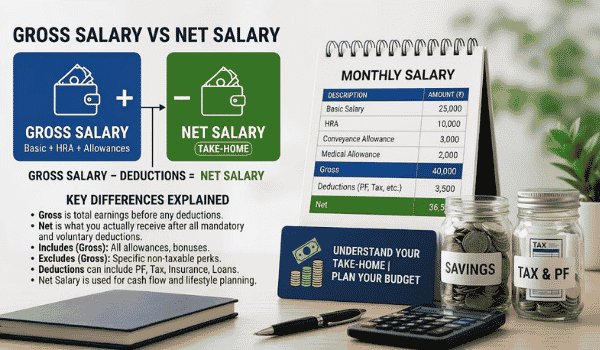
Gross Salary vs Net Salary: Every job that you do is defined by many parameters, but the most satisfying amongst them is your salary, which dictates the lifestyle planning, financial planning, savings and future goals of an employee. But most of the people get into a dilemma when they get their salary because, in most cases, the amount that is offered in the job offer, they do not receive that much amount in the bank. The confusion is typically caused by the difference between gross salary and net salary. Two of such salary terms are CTC and Net Salary, which basically every employee, job seeker and even business owner needs to know.
The terms gross salary and net salary are often used in payroll management and compensation structures. Gross Salary. The salary that an employee earns before any deductions, such as taxes and other deductions, is the salary that the employee actually receives once taxes and other deductions have been subtracted. These seem very basic concepts, but a lot of people do not fully understand how salary structures are built.
This knowledge enables employees to compare job offers better and plan a monthly budget. Also assists in individual interpretation of tax deductions and employee benefits, and provides more insight into company compensation policies.
What Is Gross Salary?
Gross Salary (gross Salary): The total amount paid to an employee before any deductions. It encompasses all aspects of the compensation package that is offered by an employer. This figure is generally found in the offer letter or contract when a company hires an employee.
Gross salary refers to the total remuneration earned by the employee and includes the following elements of your salary structure: Basic Salary, Allowances (da, hra), Bonuses, Overtime payments etc as well as any similar earnings in money or kind given by the employer. It will always be higher than the final take-home salary because it includes all of an employee’s compensation before deductions.
A gross salary is attractive for most employees since it considers the total compensation package. But as a reminder, what they take home in the bank is not at all that gross salary amount. The ultimate payable value after various obligatory deductions.
Gross salary also changes from one company, industry, and job profile to another. While some organisations offer higher allowances, several others place more emphasis on bonuses or variable pay for performance. Even with such variation, the gross salary concept is uniform across industries.
Gross Salary Calculator
What Is Net Salary?
Net salary is the sum that an employee receives after deducting all taxes and expenses from gross pay. It is also often called take-home pay or in-hand salary. This is the net amount deposited into the employee’s bank account every month.
Net salary is generally less than gross salary since the employer deducts every applicable tax, provident fund contribution, professional tax (if any), insurance premiums, etc., before making the payment. The difference between gross and net salary varies based on various factors like: Income tax slab, Company policies, Salary structure and Employee benefits.
Net salary is what employees tend to keep in mind, as it impacts their month-to-month financial planning. Net salary is used for household expenditures, savings and also investment, loan repayments, and everyday spending.
Net salary, you can say, is a bit more relevant when it comes to comparing job offers, as a company may give you gross 10lpa while it may again work out at a lower take-home due to various deductions.
Net Salary Calculator
Read Also: What is Monthly Salary
Gross Salary Vs Net Salary
There is a key difference between gross salary and net salary, which pertains to deductions. The gross salary is the total amount of money before deductions, and the net salary has been paid out as the final amount.
Gross salary refers to the total financial benefits and all the elements of the salary given to an employee by an employer unit. Through your net salary, which will only reflect the amount that will remain after paying taxes and the required by law.
Example Net salary of an employee for ₹80,000 gross/ month with total deductions of ₹10,000 will get a net salary of ₹70,000. Here, gross salary is ₹80,000 and net salary is ₹70,000.
A lot of candidates mistake gross salary from an offer letter as the salary they will receive every month. This misinterpretation may create unrealistic financial expectations. Thus, analysing salary structures is crucial before accepting any job offer.
Components Included in Gross Salary
There are multiple salary components, from which the gross salary is composed. Typically, the largest base salary forms the foundation of the employee compensation package. The gross salary is the basic salary plus other components like allowances or bonuses.
HRA (House Rent Allowance) is generally given to employees for accommodation purposes. Travel allowance, medical allowance to meet the overall cost of living, communication allowance and special allowances are all provided by some companies.
In addition, performance bonuses and incentives may also be included in the gross salary package. In certain fields, particularly sales and technology, taking a performance-based approach to bonuses can push total earnings far higher.
The salary structure will depend on the company and the position of the employee. Because of this, higher-ranking staff should get extra bonuses and incentives that increase the gross wage number.
Deductions That Reduce Gross Salary
Many deductions, such as provident fund (and its employer contribution), professional tax, insurance premium, etc., are deducted from gross salary to compute the net salary. First and foremost, income tax is one of the most prevalent deductions. All people with income over a certain amount are subject to taxes set by government authorities.
Another common deduction is Provident fund contributions. Under this scheme, a portion of the salary is contributed to the provident fund by both the employees and their employers.
In a few Indian states, professional tax may also be deducted. These could include health insurance premiums, employee welfare contributions and the salary loan under take-home salaries.
Such deductions are necessary to comply with legal and financial regulations. Any deduction decreases the net monthly income, though some deductions are meant to establish the long-term financial viability of an employee, like the provident fund.
Importance of Learning the Salary Structure
Salary Structure: Why It Matters Salary structure principles guide employees to make smart financial decisions. Most of the people (including me) are just looking into the previous annual package they were told at the time of recruitment; no one actually cares about the month it gives you.
Employees can estimate their monthly budget in advance; knowledge of gross salary vs net salary helps the employees estimate approximately. This allows them to also assess if a job offer aligns with their financial needs.
Sal structure is also helpful for employees to do Tax Planning. Well, they can use tax-saving investments in combination with deductions and exemptions to make taxable income a little lower, thereby increasing the net salary.
Employees who have a grasp on salary structures, in general, tend to be more prepared to negotiate salaries at job interviews.
SAS Salary in India – Gross Pay and Cost to Company
Cost to Company or CTC is one of the most misinterpreted term which sound very similar to gross salary. But both these terms specify differently. CTC information about the complete amount of money paid by a company every year to an employee. It encompasses both gross remuneration and employer contributions and benefits paid for insurance, allowances, bonuses, and other payroll expenses.
Gross salary is often just one segment of an entire Cost to Company (CTC) package. That is why employees are disappointed to see their real salary lower than expected after entering a company.
A company might offer a ₹12 lakh per year as CTC, but gross salary can be much less because part of the CTC constitutes the employer provident fund and other benefits.
To put it simply: You need to know the difference between gross, net and CTC in order to analyse compensation packages.
The difference between Gross Salary and Net Salary for a beginner
When freshers sit for placements, they are only concerned with the per annum salary package that is being offered by the companies. But knowing what salary deductions are is just as essential.
Although the monthly salary of a fresher getting a ₹5 lakh annual package will seem high, after deducting taxes and provident fund holders gets a reduced amount in hand.
Never accept a job until you receive a complete breakdown of wages for freshers. Doing so helps them get the real figure of what monthly earnings they will be entitled to and avoids a confused state later on.
Understanding how salary structures operate at the beginning of a career leads to better financial literacy and informed financial choices later in life.
The Tax and How It Works in Your Net Salary
Tax is one of the biggest reasons for the gross salary to the net salary. It charges employees, depending on their salary, on an annual basis and the tax regime they opt for.
Employees can also save tax using certain schemes that help in minimising the taxable income and improving the take-home salary. Hence, tax planning becomes one of the major aspects of managing the salary.
Each country and region has an individual tax system, but the fact that a tax deduction has rather lowed down the net salary does not change anywhere.
In order to save the most money, employees must understand how tax deductions work, and this can help them avoid emotionally draining themselves.
How Companies Design Salary Structures
Companies optimise their salary structures to achieve a balance between employee satisfaction and tax efficiency. Some companies actually offer flexible benefits wherein employees can select some allowances based on their needs.
Contemporary salary models usually have a component of performance-related incentives, health benefits, retirement contributions and reimbursement policies. These elements both enhance employee satisfaction and help companies strive to attract skilled labour.
Adapting flexible salary plans also gives employees the option of legally saving taxes, enhancing their net income.
Conclusion
The difference between gross salary and net salary is one of the most crucial things for employees, job seekers, and professionals at whatever stage we are in our careers. The gross salary is the amount before tax and other deductions; the net pay is what you finally receive after subtracting taxes and deductions.
A lot of people pay attention only to the salary package mentioned in job offers and calculate only the net take-home salary. This can cause all kinds of confusion; no wonder make sense. Getting a better notion of the income chairs thus allows individuals to be able to evaluate project offers accurately, utilise their financial concerns effectively and better prepare taxes all-in-all
Employees should always confirm the breakup of salary really well before accepting any job offer. Relate this to what the final salary in hand is, not gross salary or CTC, as this will finally be used for living costs/savings and for your financial planning.

Yashika is the dedicated content writer and salary research author at TheMonthlySalary.com. She specializes in creating clear, helpful, and easy-to-understand content about monthly salary, in-hand pay, salary calculators, career growth, and salary updates. Her goal is to simplify salary-related topics for employees, job seekers, students, and working professionals. Through well-researched guides and practical insights, Yashika helps readers make smarter career and financial decisions.