





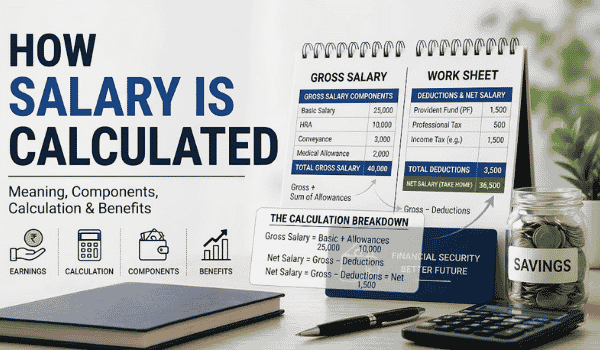
How Salary Is Calculated: Pay calculation is an integral part of all jobs, which tells how much an employee takes home after the earnings and deductions have been considered. Most employees glance over their monthly pay credit without really understanding how this value is calculated. Thus, companies have a defined process to calculate salary based on basic pay, allowances, bonuses, tax and deductions. Knowing how salary is calculated will assist you as an employee in managing your finances effectively and evaluating job offers with easier parameters.
From the outside, salary calculation may seem simple, but there are multiple components involved that combine to give you your final in-hand salary. Each company has its own basic salary structure depending on various factors, but most industries follow a similar principle of calculating the pay for their employees. Salaries are determined by employers in accordance with company rules, labour laws, tax regulations, and the conclusion of employee agreements.
Understanding the Meaning of Salary
Salary is a fixed amount of money paid by an employer to an employee in exchange for their labour. It is generally paid every month and can include various components like annual salary, allowances, incentives, and bonuses. The compensation received by employees is affected by the job role, experience, skills and qualifications obtained or acquired, size of the organisation, industry benchmarks and where they have been located.
Gross salary, Net Salary, Cost to company, and In-hand Salary are terms that most of the employees have heard about. These terms are very relevant to the valuation (in salary) process. The gross salary is the total amount of income before any deductions, whereas the net salary refers to the actual amount deposited into an employee’s account after deducting costs. Cost to company, popularly known as CTC, consists of the total amount a company spends on an employee in a single year.
These salary terms are important to understand, as many people confuse CTC and in-hand salary. While the money is paid, most times, into a bank account, there are taxes and deductions, which generally mean that the actual amount received is not as much.
Read Also: What is Monthly Salary
Components Included in Salary Calculation
Salary is a calculation of different elements together, creating an overall employee compensation package. Basic Salary: The largest element usually forms the basis for computing other allowances and deductions. Companies normally set the basic salary as a fraction of the gross pay.
In addition to the basic salary, there may be house rent allowance, travel allowance, medical allowance, special allowance and bonuses for performance. These components add to the gross salary and pay better compensation. View details below on how some allowances can be partially tax-free depending on the tax rules set by governments.
This includes retirement benefits such as employer provident fund contribution. Generally, in most companies, both the employer & employee are supposed to be contributing a certain percentage of his/her salary towards provident fund contributions. This price is deducted from the monthly salary of the employee and deposited into a provident fund account.
The calculation of the salary also takes into account professional tax, income tax, insurance premiums, and other statutory deductions. These deductions are deducted from the gross salary to arrive at a final take-home salary.
Importance of Basic Salary in Salary Calculation
The major component of salary calculation is the basic salary, since there are many other components that depend on this value. It is the amount that you will be provided before allowances or tax deductions. Basic pay typically constitutes about 40 to 50 per cent of the overall package.
With regards to salary structure, many components are reliant on the basic salary amount. The employer contribution to the provident fund is a percentage of basic pay. Usually, house rent allowance is also associated with the basic salary structure. The basic salary is also used to calculate Gratuity.
Although a sky-high basic salary may add larger retirement benefits and gratuity, it also increases tax liabilities in some cases. The companies, in turn, strive to balance the salary structure to extend tax benefits while also making sure that they stay within the labour laws.
How Gross Salary is Calculated
Gross salary Gross salary is the sum that an employee earns before any deductions. It is the fixed pay, which consists of basic salary as well as all allowances plus bonuses (if applicable) and overtime payments from the employer.
Example: If an employee gets a basic salary + house rent allowance + travel Allowance + Special allowance, all the above added are gross salary. Depending on the policy of the company, performance incentives and yearly bonuses can also be added to the gross salary.
Gross salary provides a better idea for employees about their total earnings. Yet this is not the final sum received due to taxes and deductions still coming out.
Gross Salary Calculator
Deductions and Their Significance in Salary Computation
Deductions are a major pillar of Salary Calculation because with the help of deductions, we can prepare Gross and Net salary. Companies deduct different amounts depending on government policy and company policy (benefits).
Income Taxes Income tax is perhaps the biggest deduction organisations make from the salaried employees. Employers calculate the tax as per the tax slab as well as the annual income of an employee. Old and new tax regime deductibles are dependent on which one is chosen by the employee.
Another part of salary calculation is the deduction of amounts into the provident fund. In this, the employees invest a percentage of their basic salary in retirement savings. Employers might additionally give the same quantity separately.
Some states do have a professional tax, which is charged every month and deducted from your salary. Health premiums and loan repayments (if applicable) may be deducted.
These deductions combined also affect the in-hand salary of the employee, which is the actual (in INR) amount in his bank account.
Gross Salary vs Net Salary
Gross salary and net salary are associated in such a way that many employees confuse the two. Gross Salary = Total salary before the deduction, Net Salary = Final amount in hand after all deductions are made.
So, if an employee’s gross monthly salary is fifty thousand rupees, then the provisions for provident fund and tax would result in a final net of about forty-two thousand rupees. The amount credited is called net salary / in-hand salary.
It is crucial to comprehend the distinction between these two figures when evaluating job offers or planning financial investments. Employees must always take into account the expected in-hand salary rather than focusing solely on the CT cost to the company, mentioned in offer letters.
How Bonuses Affect Salary Calculation
Bonuses are extra payments made to workers as a reward for a job well done or a company-wide achievement. Certain organisations offer yearly bonuses, festival bonuses, joining bonuses, or performance-based incentives.
Bonuses can really add up to an employee’s overall salary. Bonuses, however, are typically taxable and can raise an individual’s tax burden. Bonuses are sometimes paid out monthly, but also on a quarterly or annual basis.
Bonus is usually included in the gross salary before tax calculation. Employees in sales or performance-based roles usually depend on incentives and commissions for a big portion of their salary.
How Taxation Plays a Part in Salary Calculation
Taxes are only one of all the factors on short-list affect your pocket final in-hand salary. Governments charge income tax based on annual revenue bands on salaried people. The deducted tax depends on a system called tax deductible at source, and to this deduction, employers calculate per month basis.
Tax liabilities can be offset by employees availing deductions and exemptions as per the applicable tax laws. The old tax regime allows deduction for investments made in retirement schemes, certain insurance policies and housing loans, which may actually help to save taxes.
With the advent of the new tax regime, many employees are unsure how salary taxation works now. The regime offers lower tax rates; however, some exemptions or deductions are not permitted under the new regime. Employees are free to opt for the tax regime that is beneficial, depending on the salary structure and financial planning.
Cost to Company and the Salary Structure
Cost to the company refers to the entire cost incurred by an employer annually. Including not just fixed salary but also components like insurance, retirement contribution to be received by the staff, bonuses and so on.
Most of the employees believe that CTC is equal to in-hand salary, which is not true. Some components in CTC are not paid every month. CTC includes employer contributions for provident fund and gratuity, but doesn’t get credited to the employee’s bank account directly.
This is why employees must understand CTC in order to know better how much that job offer is really worth. It is also advantageous to compare the compensation packages of companies.
Different Salary Calculation Methods Of Different Companies
Various companies may be more or less aligned with the salary structure for each role due to industry standards or internal structures. Some companies pay a more fixed wage, while others pay more in performance incentives.
Stock options and bonuses may be part of the compensation packages offered at startups, while structured salary components and employee benefits will receive more attention from multinationals. Government agencies usually have predefined pay structures and fixed allowances.
Depending on your employment type, salary calculation also changes. Permanent workers usually get more benefits (provident fund, gratuity and insurance) along with pay to keep them safe for a larger period of time, while freelancers and contractees are full-time payments without the security of any benefits.
Conclusion
The process of salary calculation is systematic and involves the addition of earnings, allowances, deductions and tax to calculate the final in-hand salary. When employees know how their salary is derived, knowing their worth helps them make informed career choices and manage their personal financial resources more effectively.
Various components of salary affect the final variable amount, including basic pay and allowances, taxes and improv laborfund deductions. Before accepting a Job offer, Employees should check salary structures beforehand and understand the difference between gross salary, net salary and CTC.
Salary calculation has now become the most important knowledge for each working professional, and salary systems will continue to change, due to changes in tax laws and employment trends. Providing an understanding of salary structures will not only help in better financial planning but also ensure that the employees get the best out of their earnings and long-term benefits.

Yashika is the dedicated content writer and salary research author at TheMonthlySalary.com. She specializes in creating clear, helpful, and easy-to-understand content about monthly salary, in-hand pay, salary calculators, career growth, and salary updates. Her goal is to simplify salary-related topics for employees, job seekers, students, and working professionals. Through well-researched guides and practical insights, Yashika helps readers make smarter career and financial decisions.