
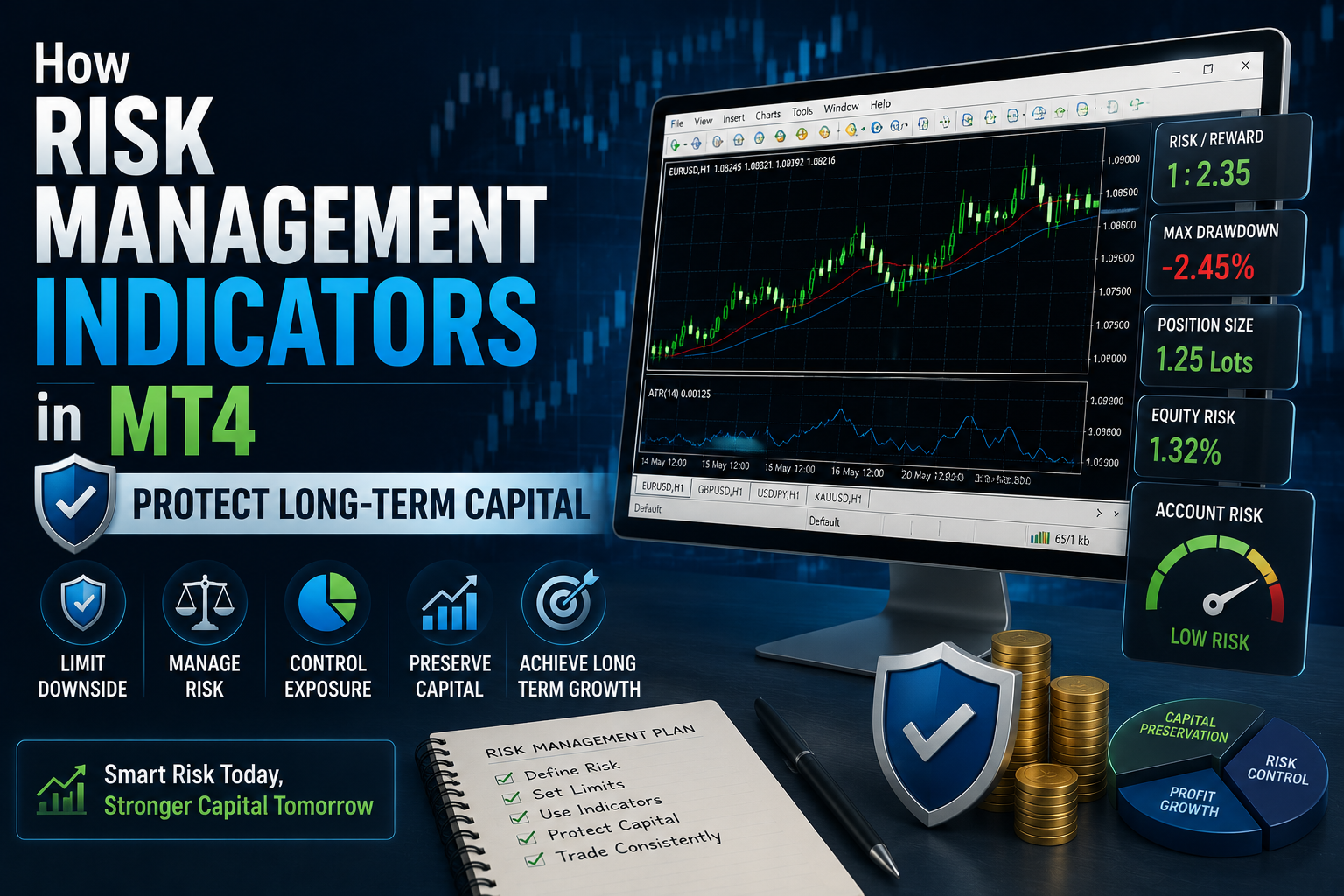





Every trader’s primary objective is to protect their capital while creating conditions for it to grow. Achieving this requires more than finding good trade setups—it demands a systematic approach to managing exposure that holds firm regardless of market conditions or emotional state. A risk management indicator MT4 provides exactly this: a structured, visual, and automated layer of risk control that operates in real time within the MetaTrader 4 environment.
This article outlines how these indicators protect trading capital, the practical mechanics behind their core features, and the professional habits they help traders build over time.
Why Capital Preservation Comes Before Profit Seeking
The mathematics of trading loss and recovery are asymmetric. A significant drawdown requires a proportionally larger gain to return the account to its original level. This asymmetry means that avoiding large losses is more valuable than chasing large wins.
This is not a philosophical point—it is a mathematical reality that defines how professional traders approach the markets. Protecting capital from outsized losses is the prerequisite for long-term profitability, and risk management indicators are built around this principle.
How MT4 Risk Indicators Work in Practice
Step 1: Define Risk Parameters
Before placing any trade, the trader sets their maximum acceptable risk using the indicator’s input settings. This includes the maximum exposure per trade relative to account equity, the minimum acceptable reward-to-risk ratio, and optionally, the maximum total open exposure across all active positions.
Step 2: Identify the Trade Setup
The trader identifies a potential entry based on their strategy. Rather than immediately calculating risk manually, they use the indicator to map the trade visually on the chart.
Step 3: Set Stop-Loss and Take-Profit Levels
Using the indicator’s visual tools, the trader positions the stop-loss below a key structural level and the take-profit at the target. The indicator immediately calculates the reward-to-risk ratio and the correct position size.
Step 4: Evaluate and Execute
If the reward-to-risk ratio meets the defined minimum and the position size aligns with the risk parameters, the trader executes. If not, the trade is passed. This entire process takes seconds with an automated risk tool—compared to minutes when done manually.
The Structural Benefits of Automation in Risk Management
Automation in risk management delivers benefits that extend well beyond speed.
Removing Cognitive Bias
Cognitive biases—anchoring, overconfidence, loss aversion—affect every trader to varying degrees. These biases influence manual risk calculations in subtle ways. A trader who is highly confident in a setup may unconsciously round up the position size. A trader who has been on a winning streak may underestimate the stop-loss distance. Automated indicators apply the same formula every time, independent of these biases.
Enforcing Pre-Trade Discipline
One of the most destructive habits in trading is placing trades reactively—entering because the market is moving, not because the setup meets defined criteria. A risk management indicator adds a natural pause to the process. The trader must engage with the tool, set the parameters, and review the output before executing. This structured pause creates space for rational evaluation.
Building a Consistent Track Record
Consistent position sizing produces a consistent equity curve, which in turn makes it possible to evaluate strategy performance accurately. Without consistent risk management, it is difficult to determine whether a strategy is genuinely profitable or simply benefiting from a period of outsized position sizes.
Key Features That Define a High-Quality MT4 Risk Indicator
Pip Value Adjustment
Different instruments have different pip values. A quality risk indicator automatically adjusts calculations based on the instrument being traded, ensuring accurate position sizing across forex pairs, metals, and other asset classes.
Multi-Position Exposure Tracking
Traders who run multiple open positions simultaneously need visibility into their total account exposure. A high-quality risk indicator aggregates this data and displays it clearly, preventing inadvertent over-exposure during active trading sessions.
Customizable Alert System
Some indicators include alert functionality that notifies the trader when a defined risk threshold is approached or breached. These alerts serve as a safety net for traders who may be monitoring multiple charts simultaneously.
Clean, Non-Intrusive Interface
A risk indicator should enhance the chart, not clutter it. The best tools display essential information concisely, using color and positioning that integrates naturally with the existing chart layout.
Common Risk Management Mistakes That Indicators Help Prevent
Oversizing Positions
Without automated position sizing, traders frequently take positions that are too large relative to their account balance. A single adverse move can result in a loss that takes significant time to recover from. A risk indicator prevents this by calculating and displaying the correct lot size before every trade.
Ignoring the Reward-to-Risk Ratio
Many traders focus on stop-loss placement but neglect to evaluate whether the target justifies the risk. An indicator that displays the reward-to-risk ratio in real time removes any excuse for ignoring this critical metric.
Inconsistent Stop-Loss Placement
Placing stop-losses based on arbitrary round numbers or gut feel—rather than structural market levels—leads to inconsistent results. While a risk indicator does not determine where the stop-loss should go, it quantifies the consequences of different placements, encouraging more deliberate decision-making.
From Reactive to Structured: The Professional Standard
The difference between reactive trading and structured trading is not talent—it is process. Reactive traders respond to what the market is doing. Structured traders evaluate setups against pre-defined criteria and execute only when those criteria are met.
A risk management indicator MT4 is a cornerstone of this structured approach. It does not generate trade ideas or predict market direction. What it does is ensure that every trade executed within the platform is sized correctly, evaluated honestly, and managed consistently.
For traders serious about long-term performance, this level of structural discipline is not optional—it is foundational.
Why is capital preservation more important than maximizing profits in trading?
The mathematics of drawdown recovery are asymmetric—larger losses require disproportionately larger gains to recover. Protecting capital from oversized losses ensures the trader remains in the game long enough for their strategy’s edge to play out over a sufficient number of trades.
Can a risk management indicator be used alongside other MT4 indicators?
Yes. MT4 supports multiple simultaneous indicators on the same chart. A risk management indicator functions as an overlay and typically does not interfere with technical analysis indicators such as moving averages, oscillators, or volume tools.
What happens if I ignore the risk indicator’s recommendations?
The indicator is a tool, not an enforcer. Traders retain full control over their execution decisions. However, consistently overriding the tool’s output defeats its purpose and reintroduces the inconsistencies the indicator is designed to prevent.
How often should I review and update my risk parameters in the indicator?
Risk parameters should be reviewed periodically—particularly after significant changes in account balance, market conditions, or trading strategy. Most traders review their parameters at the start of each trading week or after a defined number of trades.
Is MetaTrader 4 still a relevant platform for risk management tools?
Yes. Despite the release of MetaTrader 5, MT4 remains widely used due to its stability, extensive library of custom indicators, and broad broker support. Many of the most sophisticated risk management tools available are built for MT4 and continue to be actively maintained and updated.