






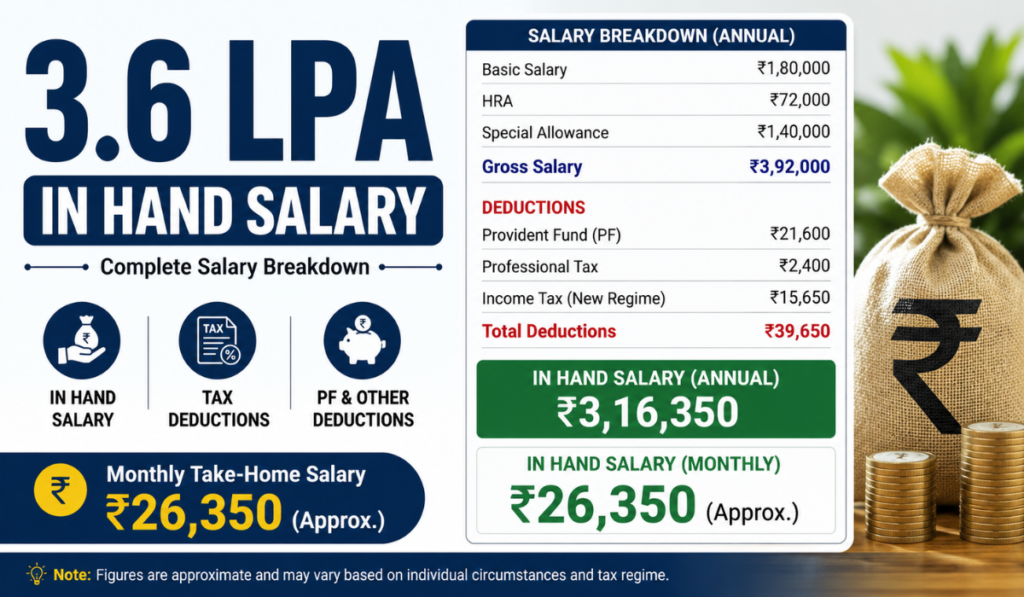
When an organisation makes a job offer of 3.6 LPA, it means the Cost to Company (CTC) is ₹3,60,000/year. But 3.6 LPA in-hand is only a little short of the actual amount, which actually lands in your Bank account every month. Understanding the Financial Terms. If you are a fresher and secure your first job, then the major problem is CTC vs take-home pay, as many freshers confuse them both and later have a surprise when they join.
LPA: Lakhs Per Annum. Therefore, the package of 3.6 LPA is actually a gross monthly number of ₹30,000 (₹3,60,000 ÷ 12). However, in reality, your CTC of 3.6 LPA will end up being a monthly salary between ₹24,000 and ₹27,000 after mandatory statutory deductions like Employee Provident Fund (EPF), Professional Tax & any applicable income tax for that year.
You need to know your in-hand salary against the 3.6 LPA before accepting any offer, so that you can plan rent, groceries, EMIs and savings. This is a very detailed, number-by-number explanation of every item that creates and deducts from your take-home from a 3.6 LPA package according to FY 2025-26 and FY 2026-27 norms.
CTC vs Gross Salary vs In-Hand Salary – Key Differences
It’s now time to discuss the calculation of 3.6 LPA in hand salary, but before we proceed to that, let’s get clear about these three terms that are commonly confused with each other in Indian employment dialogues:
CTC( Cost to Company): It is the total annual expenditure a company spends on a particular employee. This encompasses your fixed PG, allowances, the employer’s share of PF and gratuity provisions, along with any group insurance or perks. CTC is not the actual amount of money that you take home.
CTC (Cost-To-Company) is Gross Salary – employer-side deductions (employer PF contribution & gratuity provision). It means total earnings before your own deduction. The gross monthly salary is in ₹27,500–₹28,500 for a 3.6 LPA CTC
In-Hand Salary (Take-Home) is the gross salary after deduction of your employee’s PF, professional tax and TDS (income tax) from your gross salary. And this is the number that really counts when it comes to day-to-day financial planning.
| Term | Monthly Amount (Approx.) | What It Includes |
| CTC | ₹30,000 | Everything employer spends |
| Gross Salary | ₹27,500–₹28,500 | CTC minus employer PF & gratuity |
| In-Hand Salary | Everything an employer spends | Take-home after all deductions |
Read Also: 30 LPA In Hand Salary: Monthly Salary, Tax
Typical Salary Structure for a 3.6 LPA Package
Salary Structures: Indian companies have different salary structures IRL. Below is a representative breakdown of the annual and monthly figures:
| Salary Component | Annual (₹) | Monthly (₹) |
| Basic Salary (40–50% of CTC) | 1,62,000–1,80,000 | 13,500–15,000 |
| House Rent Allowance (HRA) 40–50% of Basic | 64,800–90,000 | 5,400–7,500 |
| Special / Other Allowance | 48,000–60,000 | 4,000–5,000 |
| Conveyance / Transport Allowance | 19,200 | 1,600 |
| Medical Allowance | 15,000 | 1,250 |
| Performance Bonus (variable) | 0–18,000 | 0–1,500 |
| Employer PF Contribution (12% of Basic) | 19,440–21,600 | 1,620–1,800 |
| Gratuity (4.81% of Basic) | 7,796–8,658 | 650–722 |
| TOTAL CTC | 3,60,000 | 30,000 |
Note: These are representative figures. Actual splits differ by employer. MNCs generally load some allowances to keep PF liability low, while startups may pay a higher basic
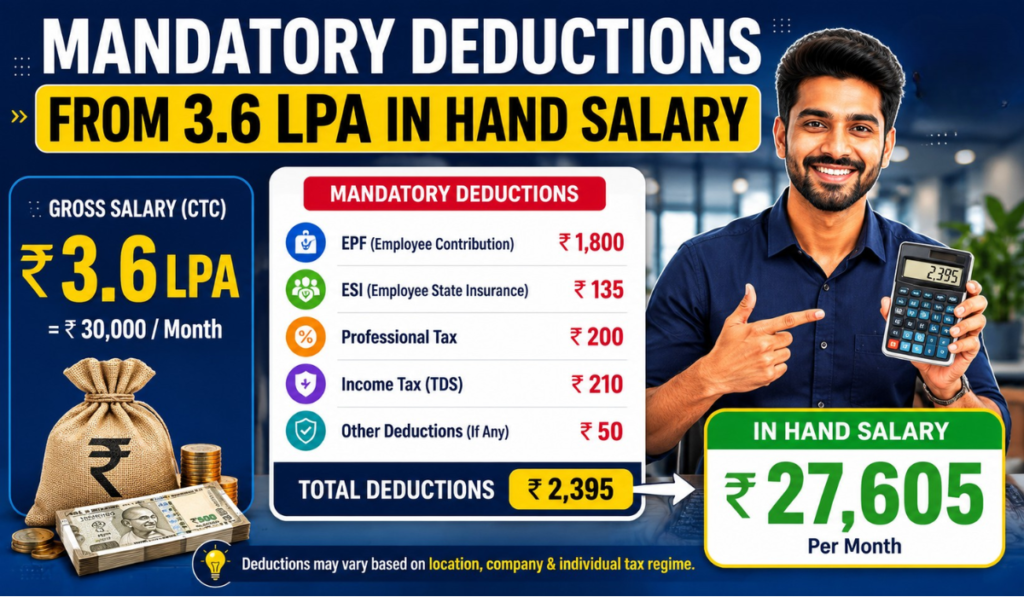
Mandatory Deductions from 3.6 LPA In Hand Salary
Three statutory deductions reduce your gross monthly salary to arrive at the 3.6 LPA in hand salary figure:
Employee Provident Fund (EPF)
Every month, 12% is cut from your basic in the name of the Employee Provident Fund. So, suppose your basic is ₹15,000/month, then the employee EPF deduction works out to be ₹1,800/month (₹21,600/year). The employer also contributes 12 % on basic, but that is included in the CTC and does not make a direct deduction from your take-home. EPF is a retirement corpus and is redeemable after 5 years of continuous service, or before under certain conditions.
Professional Tax (PT)
Professional Tax is a state-level tax. Depending on your state, it varies from ₹ 0 to ₹ 200 per month. Karnataka, Maharashtra and West Bengal ₹200/month (₹2,400/year). While Delhi, Rajasthan, Haryana and a few more states charge ₹0. PT is a nominal but real deduction at the salary level of 3.6 LPA that you should incorporate into your plans.
Income Tax / TDS
An annual income of 3.6 LPA will have zero income tax liability under the old as well as the new income tax regime for FY 2025-26 and FY 2026-27. In the proposed new tax regime, this means after ₹75,000 standard deduction, taxable income is at ₹2,85,000 within the basic exemption limit of ₹4,00,000. If the standard deduction of ₹50,000 is applied under the old regime, then the taxable income drops to below ₹3,00,000, and so tax liabilities would still be nil. So, TDS = 0 and hence for a 3.6 LPA earner §
| Deduction Type | Monthly (₹) | Annual (₹) |
| Employee EPF (12% of Basic ₹15,000) | 1,800 | 21,600 |
| Professional Tax (e.g. Karnataka/Maharashtra) | 200 | 2,400 |
| Income Tax (TDS) | 0 | 0 |
| TOTAL DEDUCTIONS | 2,000 | 24,000 |
Final In-Hand Salary Calculation for 3.6 LPA
Putting it all together, here is how the 3.6 LPA in hand salary calculation works in a step-by-step manner:
| Calculation Step | Monthly (₹) | Annual (₹) |
| CTC | 30,000 | 3,60,000 |
| Less: Employer PF contribution | −1,800 | −21,600 |
| Less: Gratuity provision | −700 | −8,400 |
| = GROSS SALARY | 27,500 | 3,30,000 |
| Less: Employee EPF deduction | −1,800 | −21,600 |
| Less: Professional Tax (PT) | −200 | −2,400 |
| Less: Income Tax (TDS) | 0 | 0 |
| = IN-HAND SALARY (Take-Home) | 25,500 | 3,06,000 |
So your ₹3.6 LPA in hand salary works out to roughly ₹25,500 per month in professional tax states and ₹26,000–₹27,000 at nil professional tax (Delhi, etc.) The number may differ by ₹500–₹1,500 depending on your salary structure fixed by a particular employer, basic percentage and if variable pay is taken into account.
Read Also: 14 LPA In Hand Salary: Complete Breakdown, Tax Calculation
Old Tax Regime vs New Tax Regime at 3.6 LPA
The most frequently asked question about a 3.6 LPA in hand salary is which tax regime is better? The great news: neither system ultimately applies any income tax at this level, so there is no direct tax impact from the choice. However, knowing the difference can better prepare you for when your compensation increases.
| Factor | Old Tax Regime | New Tax Regime (Default) |
| Standard Deduction | ₹50,000 | ₹75,000 |
| Basic Exemption Limit | ₹2,50,000 | ₹4,00,000 |
| Section 87A Rebate | ₹12,500 (upto 5 LPA) | ₹60,000 (upto 12 LPA) |
| HRA Exemption | Available | Not available |
| Section 80C deductions | Up to ₹1.5 lakh | Not available |
| Tax at 3.6 LPA | Nil | Nil |
| Recommended at 3.6 LPA? | Either works | Simpler; recommended |
Default tax regime from FY 2024-25 onwards. At this level, neither regime affects your 3.6 LPA in hand salary, so the new regime is simpler to deal with unless your employer has based your pay on old-regime exemptions such as HRA or medical reimbursements.
City-wise Variation in 3.6 LPA In Hand Salary
Your in-hand salary at 3.6 LPA can be slightly higher or smaller based on location: the professional tax cuts, the cost-of-living component of the salary structure component itself or even centres.
| City / State | Professional Tax/Month | Est. In-Hand/Month | Net Annual |
| Bengaluru (Karnataka) | ₹200 | ₹25,500 | ₹3,06,000 |
| Mumbai (Maharashtra) | ₹200 | ₹25,500 | ₹3,06,000 |
| Kolkata (West Bengal) | ₹200 | ₹25,500 | ₹3,06,000 |
| Hyderabad (Telangana) | ₹150–₹200 | ₹25,500–₹25,550 | ₹3,06,000+ |
| Chennai (Tamil Nadu) | ₹150–₹208 | ₹25,492–₹25,550 | ≈₹3,06,000 |
| Delhi / NCR | ₹0 | ₹27,000–₹27,500 | ₹3,24,000+ |
| Pune (Maharashtra) | ₹200 | ₹25,500 | ₹3,06,000 |
One of the biggest benefits for students in Delhi is that there are no professional taxes and hence, it offers the maximum 3.6 LPA in hand salary. The gap is not much in practical terms (₹200/month) but translates into ₹2,400 more annually for staff in Delhi.
Is 3.6 LPA In Hand Salary Good in India?

How good or enough is 3.6 LPA in-hand salary is a thing based on the city you live in and your lifestyle, along with financial goals that depend heavily on the place where one lives. Here is a practical breakdown:
Tier 1 Cities (Mumbai, Bengaluru, Delhi, Hyderabad)
₹25,500 per month is a tight budget in metro cities. The rent of 1-BHK apartments varies from ₹8,000 to ₹18,000 based on the location. Once rent, comm parla cordes, food and utilities are deducted, there is little disposable income. But many freshers begin at 3.6 LPA in these cities and use it as a launch pad, anticipating huge hikes over the following 12–18 months.
Tier 2 & Tier 3 Cities (Jaipur, Indore, Lucknow, Coimbatore)
A 3.6 LPA in hand salary of about ₹25,500/month is a truly comfortable life, even for T2 & T3 cities. Rent is ₹4,000 ₹8,000, food cost is even less, and a sizeable sum is saved every month. 3.6 LPA is a decent freshers’ package for such cities.
Monthly Budget Template for 3.6 LPA In Hand Salary
Presenting a basic Monthly Budget of a 3.6 LPA in-hand salary amount of ₹25,500/month for Tier 1 & Tier 2 City:
| Expense Category | Tier 1 (₹) | % of Income | Tier 2 (₹) | % of Income |
| Rent / Accommodation | 12,000 | 47% | 6,000 | 24% |
| Food & Groceries | 4,500 | 18% | 3,500 | 14% |
| Transport / Commute | 2,000 | 8% | 1,000 | 4% |
| Utilities (Phone, Internet, Electricity) | 1,500 | 6% | 1,200 | 5% |
| Entertainment & Miscellaneous | 2,000 | 8% | 1,500 | 6% |
| Health & Personal Care | 500 | 2% | 500 | 2% |
| Savings / Investment | 3,000 | 12% | 11,800 | 46% |
| TOTAL | 25,500 | 100% | 25,500 | 100% |
The contrast is stark. For an individual earning 3.6 LPA in hand salary, who lives in a Tier 2 city, he could have saved close to ₹11,800/month, which builds value-based thematic financial security. Artificial Intelligence and Analytics Data Quality in a Tier 1 City, Rent Is Pressuring Discretionary Spending And Savings
Read Also: 20 LPA In Hand Salary: Monthly Income, Deductions
How to Increase Your 3.6 LPA In Hand Salary
Within a 3.6 LPA CTC, there are some genuine methods to increase your monthly in-hand salary too!
Sign up for HRA structuring: If you stay in rented accommodation, make sure that your employer divides your salary such that the HRA component is a significant portion. For example, the HRA exemption serves to reduce your taxable income, but at 3.6 LPA, this yields you no direct tax benefits now, but puts you in a good position for salary hikes down the line under the new tax regime.
Then there is one more option: eligible employees can completely opt out of PF in some private sector firms for those workers whose monthly salary exceeds the statutory wage ceiling of ₹15,000. It would mean, in effect, a ∼₹1,800/month increase in your take-home salary, taking your effective 3.6 LPA net /take-home salary (now) from ₹25,500 to ₹27,300. But you then forfeit the benefit of EPF accumulation over your long-term retirement needs.
Impulse negotiations, food coupons, and meal allowances: With effect from ₹2,200/month, the meal coupon (Sodexo or Zeta) with zero tax is allowed across regimes, increasing real disposable income.
Negotiate for reimbursements rather than allowances: Telephone and internet reimbursements, fuel reimbursements, or professional development allowances translate to tax-free value within your CTC without creating a burden on the tax front.
Performance-linked pay: Make sure to state if your compensation is linked to variable pay in the offer letter. In fact, at various organisations, an incentive of ₹10,000–₹30,000 per quarter or annually can meaningfully add to the in-hand salary across a year on the ₹3.6 LPA figure.
Industries and Job Roles That Offer 3.6 LPA
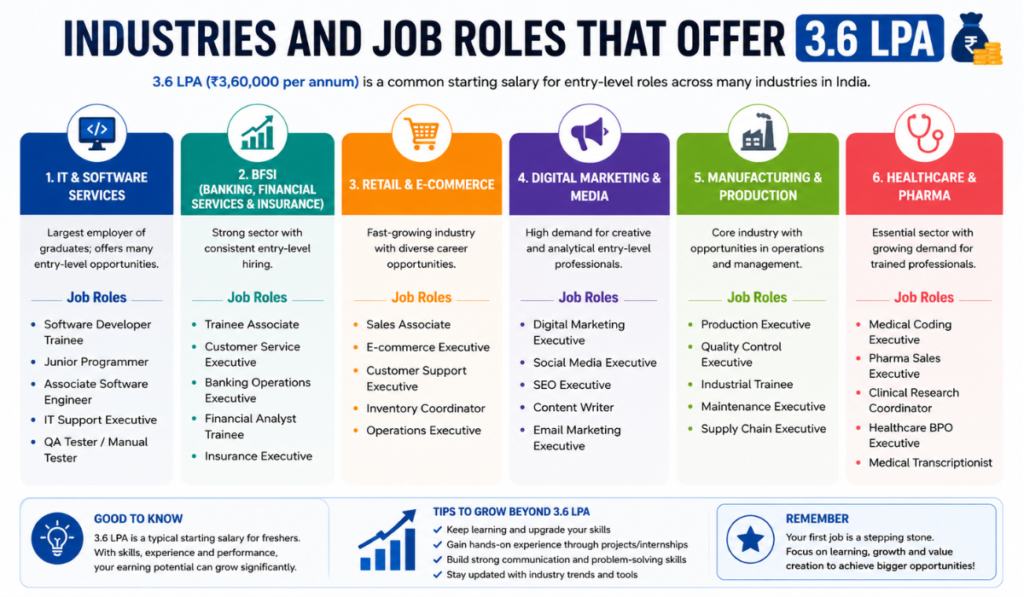
The 3.6 LPA CTC is a common fresher and entry-level package in many sectors across India. It helps to know where in the industries these salary numbers come from:
| Industry | Common Roles | Typical Starting CTC |
| IT / Software Services | Junior Developer, QA, Support | 3.0–4.5 LPA |
| BPO / KPO / ITES | Customer Support, Data Entry | 2.5–4.0 LPA |
| Banking & Financial Services | Analyst, Relationship Manager | 3.0–5.0 LPA |
| Retail & FMCG (Sales) | Territory Sales Officer, ASM | 3.0–4.5 LPA |
| Healthcare / Pharma | MR, Lab Technician, Admin | 2.8–4.0 LPA |
| Logistics & Supply Chain | Executive, Coordinator | 3.0–4.5 LPA |
| EdTech & Startups | Content, Sales, Ops | 3.0–5.0 LPA |
Read Also: 4.5 LPA In Hand Salary || 6 LPA In Hand Salary
Frequently Asked Questions (FAQ)
Q1. What is in-hand salary per month on a 3.6 LPA?
The in hand monthly salary of 3.6 LPA amounts to roughly around ₹25,500 (states with ₹200/month as professional tax like Karnataka, Maharashtra) or nearly ₹27K–₹27000 (states with nil professional tax like Delhi). This is considering an all-in gross pay of ₹15,000/month, which means EPF is being deducted at ₹1,800/month, and there is no income tax.
Q2. How much tax on a 3.6 LPA salary?
No. For FY 2025-26 and FY 2026-27, under the new tax regime, the basic exemption limit is ₹4,00,000 and standard deduction of ₹75,000, hence zero tax applies on a 3.6 LPA income. Under the old tax regime, with a standard deduction of ₹50,000 pushing taxable income to below ₹3,00,000, it means nil tax. Hence, the TDS deduction on a salary of 3.6 LPA is ₹0
Q3. What is 3.6 LPA per month CTC?
3.6 LPA = ₹30,000 monthly CTC (₹3,60,000 ÷ 12). But, this is not what you take home. Employer PF (₹1,800), gratuity provision (≈₹700) and many other employer-side costs that never hit your bank account every month.
Q4. For a 3.6 LPA: How is your PF calculated?
PF (Provident Fund): PF is calculated at 12% of basic salary. For example, if your basic salary is ₹15,000/month, then employee EPF contribution: 12% × ₹15,000 = ₹1,800/month. The employer also contributes ₹1,800/month towards this, but since it is part of your CTC, it does not lower your in-hand pay further.
Q5. Is professional tax applicable to a 3.6 LPA salary?
If you have an employer in states like Karnataka, Maharashtra, West Bengal, Andhra Pradesh or Tamil Nadu, yes, your salary is dented by ₹150–₹200/month as professional tax (PT). Delhi, Rajasthan and Haryana do not have professional tax as well, and so employees in these three states are left with a slightly higher 3.6 LPA take-home salary.
Q6. The difference is only on paper in hand salary matters a lot.
The in-hand monthly salary for a 3 LPA package is around ₹22,500–₹23,500, and the same for a 3.6 LPA in hand salary is about ₹25,500–₹27,000 per month. The additional ₹60,000 per annum in CTC means about ₹ 2,000–₹ 3,000 more in monthly take-home, as there is no additional income tax at either level.
Q7. Can I have a higher in-hand inside the same 3.6 LPA CTC?
Yes. You can negotiate to realign your income components: a higher HRA (if you stay on rent), meal/food coupons (tax-free up to ₹2,200/month), phone or internet reimbursements and also choose EPF exemption if your employer allows it. Such moves can drive your in-hand salary of 3.6 LPA from ₹25,500 to a whopping ₹27,000–₹28,000 with the CTC headline remaining intact.
Q8. What is the salary of a fresher in India?
A definitive absolute answer to this. Many factors come into play when answering this question.
As an example, 3.6 LPA is a standard and average starting salary for a fresher in India across IT services (services sector), BPOs, banking, FMCG and other such sectors, which are highly employable. It is a decent enough income in Tier 2 or Tier 3 cities. In metros, where it is de facto even lower, it covers basic needs but may offer little to save or spend on lifestyles. So generally, professionals feel entitled to a 20–30% hike in 12–18 months after their first appraisals at this stage.
Q9. What are common deductions on a 3.6 LPA Salary?
The major deductions from a 3.6 LPA salary include: Employee EPF (₹1,800/month), Professional Tax (₹0–₹200/month based on state) and Income Tax/TDS (₹0 at this CTC). The total deduction is usually Rs 1,800-2,000/month, which means a gross salary of Rs 27,500 comes down to a net take-home of Rs 25,500 – Rs 27,000.
Q10. What is the effect of gratuity on the in hand salary of 3.6 LPA?
Gratuity is computed at the rate of 4.81% of basic salary per annum. This works out to around ₹700/month (₹8,658/year) for a basic of ₹15,000/month. This is included in CTC but not received month after month; this amount accumulates & will be received as a lump sum after completion of 5 years with the same employer. Since gratuity is calculated in the make-up of CTC but not disbursed monthly, it ends up reducing your take-home salary package of 3.6 LPA even if you haven’t received it yet.
Conclusion
Realising: 3.6 LPA in-hand is way more important than the CTC headline number on the offer letter. The gist is: If a 3.6 LPA CTC gives you ₹30,000/month in hand, once statutory deductions are accounted for, it probably becomes closer to ₹25,500 a month (around ₹4,500 short), or around ₹54,000 less per annum.
The positive thing about both regimes is that there are no income tax liabilities at this salary level, so the only leakages are EPF and professional tax. And EPF is not a loss; it was a mandatory savings scheme paying 8.1%+ per annum interest. HRA planning coupled with smart salary restructuring and sending targeted negotiation work could push your 3.6 LPA in hand Salary near to ₹27,000/₹28,000/month.
A starting salary package of 3.6 LPA in hand for freshers and early-career professionals, NOT a result. This package should be a stop on your way to upskilling. Delivery excellence and proactive appraisal conversations are key to growing up to this package in the next 12-18 months. It’s all about the trajectory, not the initial figure.
Read Also: 7 LPA In Hand Salary || 2 LPA In Hand Salary || 3 LPA In Hand Salary in India

Prashant Kumar is the dedicated content writer and salary research author at TheMonthlySalary.com. He specializes in creating clear, helpful, and easy-to-understand content about monthly salary, in-hand pay, salary calculators, career growth, and salary updates. My goal is to simplify salary-related topics for employees, job seekers, students, and working professionals. Through well-researched guides and practical insights, Prashant helps readers make smarter career and financial decisions.